



Control and Management
Control and Management
Filter Total Items: 43
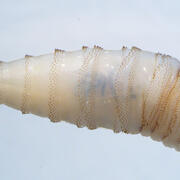
Responding to New World Screwworm in the U.S.
The USGS National Wildlife Health Center (NWHC) is supporting the Department of the Interior’s (DOI) preparedness planning and response for New World screwworm (NWS), an invasive parasitic fly detected in the U.S. in June 2026 after its northward spread from Central America.

White-nose Syndrome Vaccine Updates
Since its emergence in 2006, white-nose syndrome (WNS) continues to spread in North America and has substantially impacted hibernating bat populations, contributing to declines of over 90% in northern long-eared ( Myotis septentrionalis), little brown ( Myotis lucifugus), and tri-colored bat ( Perimyotis subflavus) populations. We are developing tools and management strategies to protect bat...

INHABIT: A web tool for invasive plant management across the contiguous United States
INHABIT is a desktop-optimized web application and decision support tool with mapped and tabular summaries of habitat suitability models for over two hundred fifty terrestrial invasive plant species of management concern across the contiguous United States. It is the product of a scientist-practitioner partnership and is designed to facilitate enhanced invasive species management actions...
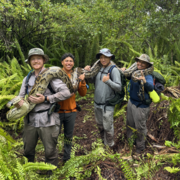
Invasive Burmese python research in the Greater Everglades
USGS leads federal research to control the highly invasive Burmese python ( Python bivittatus), which has become firmly established across the Greater Everglades Ecosystem and poses a serious threat to native wildlife. Capable of reaching over 17 feet long, this massive constrictor is believed to be a key factor in the sharp decline of mammal populations in the region. For over a decade...
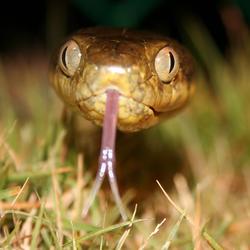
A Matter of Scales: USGS Science to Reduce Invasive Snake Impacts
The U.S. Geological Survey Ecosystem Mission Area plays a major role in invasive snake science across the country and the globe, ranging from research on improving snake detection to projects that enhance eradication. Our extensive science ultimately scales up to benefiting public health, energy transmission, tourism, and other key aspects of American prosperity.

Key Values of a Century of EESC Science
The USGS Eastern Ecological Science Center (EESC) is rooted in a proud tradition of service to the nation—advancing science that informs the conservation and management of fish, wildlife, and habitats across the eastern United States and beyond. Our mission is clear: deliver reliable, partner-driven science that supports natural resource decisions today, while ensuring these resources remain...
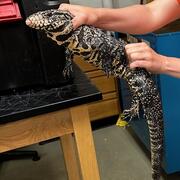
Early detection and rapid response tools for invasive tegu lizards
Scientists at USGS have shown that much of the US is suitable for invasion by tegu lizards, and suitability will likely increase in the future. While tegus can be removed via trapping, it is difficult to monitor every geographic area where tegus could invade. Thus, methods for quickly detecting and removing tegus in new areas are the best way to prevent spread and minimize damage from these...

SBSC science supports invasive species management
Invasive species can harm ecosystems, increase wildfires, damage forests, and outcompete native species. The US Geological Survey's Southwest Biological Science Center conducts research that provides our federal and state partners, cooperators and land managers with the tools, data and strategies to enhance biosecurity management. Scroll through the information below to read about different SBSC...

Improve Control Efficiency Through Better Understanding of Grass Carp Movements and Habitat Use
The goal of this project is to address the threat of invasive Grass Carp by developing a comprehensive understanding of seasonal movements, habitat use, and areas of aggregation to determine when and where eradication efforts would be most effective.

Avian Influenza Surveillance
The USGS National Wildlife Health Center (NWHC) conducts surveillance in wild birds to facilitate early detection and situational awareness for high consequence pathogens, including highly pathogenic avian influenza (HPAI) viruses.

Assessing the Proliferation, Connectivity, and Consequences of Invasive Fine Fuels on the Sagebrush Biome
Invasive annual grasses can replace native vegetation and alter fire behavior, impacting a range of habitats and species. A team of researchers from the U.S. Geological Survey, Colorado State University, the Bureau of Land Management, and the U.S. Fish and Wildlife Service are working to identify factors that influence changes in the distribution and abundance of invasive annual grasses (IAGs)...

Monitoring Bird and Rat Behavior to Improve Invasive Species Management
Introduced rats are notorious predators of birds and their nests worldwide, but especially on remote islands. Rats ( Rattus exulans) first arrived in Hawai‘i with Polynesian colonists about 1,000 years ago, resulting in deleterious consequences for native birds and ecosystems. Since Western contact in 1778, two additional rat species have become established in Hawai‘i, including the highly...