



On-site mobile laboratory located near groundwater monitoring wells on Cape Cod, Massachusetts
Larry B Barber, II
Dr. Larry Barber is a Research Geologist with the USGS Water Resources Mission Area and Integrated Water Chemistry Assessment Laboratory.
I joined the USGS NRP as a student appointments in 1982. Since then, my research has involved long-term interdisciplinary research projects that characterize environmental sources of organic and inorganic contaminants, quantify the biogeochemical processes that control their fate, and assess their potential effects on aquatic ecosystems and human health. Particular emphasis is focused on the interactions between chemistry, hydrology, and biology. A major area of expertise is the analysis of emerging contaminants by gas chromatography/tandem mass spectrometry, which provides a foundation for assessing their occurrence, exposure pathways, and impacts.
Current research focuses on biologically-active contaminants and receiving water (surface water and groundwater) attenuation capacity. Compounds being investigated include endocrine disrupting chemicals, neuro-active pharmaceuticals, and antimicrobials. We develop state-of-the-science approaches to landscape-based, watershed-scale (second-order streams to continental rivers) evaluation of chemical loading and fate combined with the field-based biological assays, to establish a holistic understanding of contaminant behavior and impacts. This interdisciplinary research involves teams of scientists to allow comprehensive evaluation of critical water resource issues.
Science and Products
Filter Total Items: 13
Not All PFAS Are Alike: Fish Responses Reveal The Importance Of Real-World Mixtures
A USGS study demonstrates the importance of monitoring not just the amount of PFAS in groundwater, but the PFAS mixture present. Building on two decades of experience conducting mobile laboratory experiments, USGS researchers applied this approach at a contaminated fire training area to evaluate how fish respond to complex PFAS mixtures, providing important scientific evidence that can improve how...
A Decade of Data Reveals Imidacloprid (a common insecticide) is Increasing in American Rivers
Imidacloprid, a commonly used insecticide in both agricultural and urban settings, is reaching rivers and streams across the country, where it can potentially harm the aquatic insects and other organisms that support healthy freshwater ecosystems. A decade‑long USGS study found this insecticide in nearly half of all samples, often at levels above chronic health benchmarks and present throughout...
Applying Multiple Tools to Inform Management of Per- and Polyfluoroalkyl Substances (PFAS) in the Potomac River Watershed
The reuse of municipal wastewater provides multiple benefits, including maintaining stream flow, recharging aquifers, and providing public water supply. However, along with the benefits are concerns related to the presence of ‘forever’ chemicals, like per- and polyfluoroalkyl substances (PFAS) in wastewater discharge. Managing PFAS in waterways is challenging because there are many potential PFAS...

Navigating PFAS Contamination: Insights from the USGS Potomac River Watershed Study
The Potomac River is a major watershed in the eastern United States that serves as a crucial water supply for millions of people. USGS researchers conducted a comprehensive investigation to identify the contributions of municipal and industrial wastewater treatment plant effluent to the levels of per-and polyfluoroalkyl substances (PFAS) in the Potomac River. This study included measuring PFAS...

Human-Related Compounds in Water Sources in the Grand Canyon Help Identify Water Flow Pathways and Highlight Potential Water Quality Changes
U.S. Geological Survey (USGS) scientists investigated the movement of human-generated chemicals, such as pharmaceuticals and per- and polyfluorinated substances (PFAS), in groundwater along the South Rim of the Grand Canyon. This research led to a better understanding of the movement of wastewater into groundwater, of complex underground flow patterns, and of chemicals present in springs near...

Unique Approach to Measure Per- and Polyfluoroalkyl Substances Uptake in Fish, Mussels, and Passive Samplers
Per- and polyfluoroalkyl substances (PFAS) uptake and bioconcentration by fish and mussels ─ housed in mobile laboratories at a legacy fire-training area contaminated by aqueous film-forming foams ─ varied by species, sex, and compound. PFAS in passive samplers deployed at the same time mimicked uptake by fish but not mussels indicating that passive samplers might prove useful as screening tools...

Integrated Assessments of Potential Risks to Aquatic Organisms and Public Water Supply from Wastewater-Derived Chemical Mixtures in the Chesapeake Bay Watershed
Proper management of contaminants of emerging concern in the Chesapeake Bay region requires scientific efforts to understand the risk posed to aquatic resources from the “cocktail” of multiple contaminants that is often present. This research aims to assess the occurrence, sources, environmental impacts, biological effects, and the human health impacts of toxic contaminants in rivers.

Refined Model Provides a Screening Tool to Understand Exposure to Contaminants from Incidental Wastewater Reuse
Refinement of the existing national-scale “de facto reuse incidence in our nation’s consumable supply” (DRINCS) model, complemented by field measurements, provides a screening tool to understand human and wildlife exposure to toxicants and pathogens associated with the incidental reuse of treated wastewater in the Shenandoah River watershed. The model results can be accessed in a companion web...

GIS-based landscape analysis to identify sources of endocrine disrupting chemicals
A key component to assessing the contaminant exposure pathways in streams and rivers of the Chesapeake Bay is using GIS-based landscape analysis to identify sources of endocrine disrupting chemicals. Municipal and industrial wastewater treatment plant (WWTP) discharges are potentially major sources of EDCs to streams, and therefore understanding the de facto wastewater reuse (represented as...

Per- and Polyfluoroalkyl Substances From Firefighting and Domestic Wastewater Remain in Groundwater for Decades
New study explores the persistence and transport of poly- and perfluoroalkyl substances (PFASs) that originated from both firefighting and domestic wastewater sources. Although the fire training area and wastewater facility were decommissioned over 20 years ago, both sites continue to be sources of PFASs to groundwater.

Long-Term Study Finds Endocrine Disrupting Chemicals in Urban Waterways
U.S. Geological Survey (USGS) scientists determined that endocrine disrupting chemicals (EDCs) were present in wastewater treatment plant (WWTP) effluent, water, and fish tissue in urban waterways in the Great Lakes and upper Mississippi River Regions (Indiana, Illinois, Michigan, Minnesota, and Ohio) during 1999 through 2009.

Neuroactive Pharmaceuticals in Minnesota Rivers
A team of scientists from the U.S. Geological Survey (USGS) and the University of Colorado measured seven neuroactive pharmaceutical compounds in treated wastewater and downstream receiving waters at 24 sites across Minnesota. The analysis of samples collected upstream and downstream of wastewater treatment plants indicated that wastewater treatment plants were the major source of these chemicals.
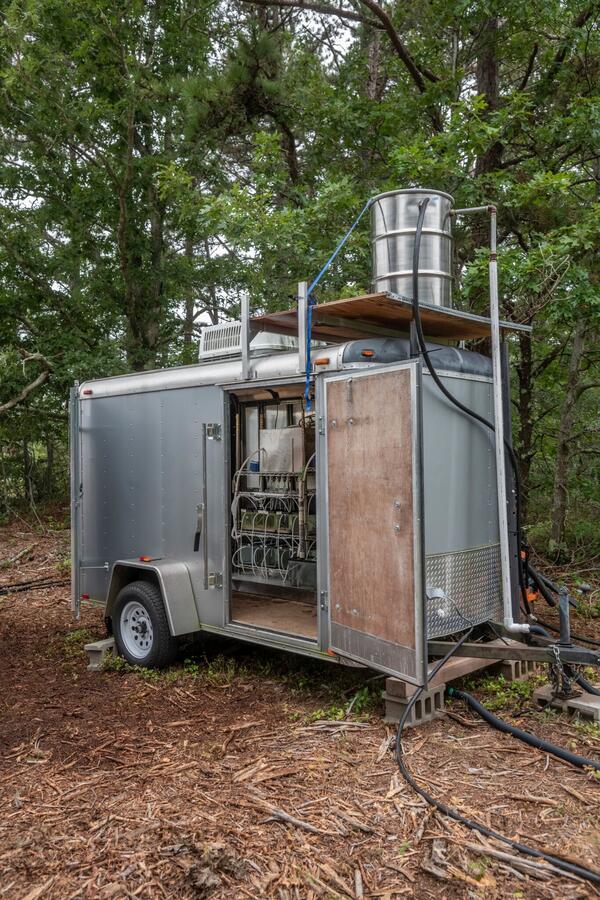
Mobile Laboratory
On-site mobile laboratory located near groundwater monitoring wells on Cape Cod, Massachusetts
On-site mobile laboratories
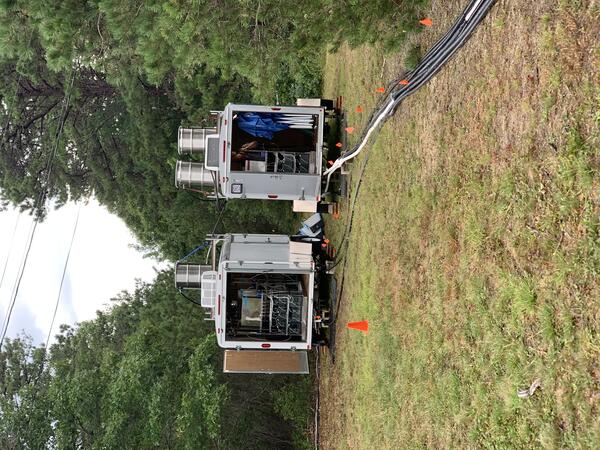
On-site mobile laboratories located near groundwater monitoring wells on Cape Cod, Massachusetts
On-site mobile laboratories located near groundwater monitoring wells on Cape Cod, Massachusetts

Fathead minnows swimming in an experimental aquarium
Fathead minnows swimming in an experimental aquariumFathead minnows (Pimephales promelas) swimming in an expermental aquaium. The aquarium is part of an experiment to assess endocrine disruption in fish.
Fathead minnows swimming in an experimental aquarium
Fathead minnows swimming in an experimental aquariumFathead minnows (Pimephales promelas) swimming in an expermental aquaium. The aquarium is part of an experiment to assess endocrine disruption in fish.

Fathead minnows swimming in an experimental aquarium
Fathead minnows swimming in an experimental aquariumBioactive Chemicals Research Laboratory — Boulder, Colorado. Fathead minnows (Pimephales promelas) swimming in an experimental aquarium. The aquarium is part of an experiment to assess endocrine disruption in fish.
Fathead minnows swimming in an experimental aquarium
Fathead minnows swimming in an experimental aquariumBioactive Chemicals Research Laboratory — Boulder, Colorado. Fathead minnows (Pimephales promelas) swimming in an experimental aquarium. The aquarium is part of an experiment to assess endocrine disruption in fish.
Science and Products
Filter Total Items: 13
Not All PFAS Are Alike: Fish Responses Reveal The Importance Of Real-World Mixtures
A USGS study demonstrates the importance of monitoring not just the amount of PFAS in groundwater, but the PFAS mixture present. Building on two decades of experience conducting mobile laboratory experiments, USGS researchers applied this approach at a contaminated fire training area to evaluate how fish respond to complex PFAS mixtures, providing important scientific evidence that can improve how...
A Decade of Data Reveals Imidacloprid (a common insecticide) is Increasing in American Rivers
Imidacloprid, a commonly used insecticide in both agricultural and urban settings, is reaching rivers and streams across the country, where it can potentially harm the aquatic insects and other organisms that support healthy freshwater ecosystems. A decade‑long USGS study found this insecticide in nearly half of all samples, often at levels above chronic health benchmarks and present throughout...
Applying Multiple Tools to Inform Management of Per- and Polyfluoroalkyl Substances (PFAS) in the Potomac River Watershed
The reuse of municipal wastewater provides multiple benefits, including maintaining stream flow, recharging aquifers, and providing public water supply. However, along with the benefits are concerns related to the presence of ‘forever’ chemicals, like per- and polyfluoroalkyl substances (PFAS) in wastewater discharge. Managing PFAS in waterways is challenging because there are many potential PFAS...
Navigating PFAS Contamination: Insights from the USGS Potomac River Watershed Study
The Potomac River is a major watershed in the eastern United States that serves as a crucial water supply for millions of people. USGS researchers conducted a comprehensive investigation to identify the contributions of municipal and industrial wastewater treatment plant effluent to the levels of per-and polyfluoroalkyl substances (PFAS) in the Potomac River. This study included measuring PFAS...
Human-Related Compounds in Water Sources in the Grand Canyon Help Identify Water Flow Pathways and Highlight Potential Water Quality Changes
U.S. Geological Survey (USGS) scientists investigated the movement of human-generated chemicals, such as pharmaceuticals and per- and polyfluorinated substances (PFAS), in groundwater along the South Rim of the Grand Canyon. This research led to a better understanding of the movement of wastewater into groundwater, of complex underground flow patterns, and of chemicals present in springs near...
Unique Approach to Measure Per- and Polyfluoroalkyl Substances Uptake in Fish, Mussels, and Passive Samplers
Per- and polyfluoroalkyl substances (PFAS) uptake and bioconcentration by fish and mussels ─ housed in mobile laboratories at a legacy fire-training area contaminated by aqueous film-forming foams ─ varied by species, sex, and compound. PFAS in passive samplers deployed at the same time mimicked uptake by fish but not mussels indicating that passive samplers might prove useful as screening tools...
Integrated Assessments of Potential Risks to Aquatic Organisms and Public Water Supply from Wastewater-Derived Chemical Mixtures in the Chesapeake Bay Watershed
Proper management of contaminants of emerging concern in the Chesapeake Bay region requires scientific efforts to understand the risk posed to aquatic resources from the “cocktail” of multiple contaminants that is often present. This research aims to assess the occurrence, sources, environmental impacts, biological effects, and the human health impacts of toxic contaminants in rivers.
Refined Model Provides a Screening Tool to Understand Exposure to Contaminants from Incidental Wastewater Reuse
Refinement of the existing national-scale “de facto reuse incidence in our nation’s consumable supply” (DRINCS) model, complemented by field measurements, provides a screening tool to understand human and wildlife exposure to toxicants and pathogens associated with the incidental reuse of treated wastewater in the Shenandoah River watershed. The model results can be accessed in a companion web...
GIS-based landscape analysis to identify sources of endocrine disrupting chemicals
A key component to assessing the contaminant exposure pathways in streams and rivers of the Chesapeake Bay is using GIS-based landscape analysis to identify sources of endocrine disrupting chemicals. Municipal and industrial wastewater treatment plant (WWTP) discharges are potentially major sources of EDCs to streams, and therefore understanding the de facto wastewater reuse (represented as...
Per- and Polyfluoroalkyl Substances From Firefighting and Domestic Wastewater Remain in Groundwater for Decades
New study explores the persistence and transport of poly- and perfluoroalkyl substances (PFASs) that originated from both firefighting and domestic wastewater sources. Although the fire training area and wastewater facility were decommissioned over 20 years ago, both sites continue to be sources of PFASs to groundwater.
Long-Term Study Finds Endocrine Disrupting Chemicals in Urban Waterways
U.S. Geological Survey (USGS) scientists determined that endocrine disrupting chemicals (EDCs) were present in wastewater treatment plant (WWTP) effluent, water, and fish tissue in urban waterways in the Great Lakes and upper Mississippi River Regions (Indiana, Illinois, Michigan, Minnesota, and Ohio) during 1999 through 2009.
Neuroactive Pharmaceuticals in Minnesota Rivers
A team of scientists from the U.S. Geological Survey (USGS) and the University of Colorado measured seven neuroactive pharmaceutical compounds in treated wastewater and downstream receiving waters at 24 sites across Minnesota. The analysis of samples collected upstream and downstream of wastewater treatment plants indicated that wastewater treatment plants were the major source of these chemicals.
Mobile Laboratory
On-site mobile laboratory located near groundwater monitoring wells on Cape Cod, Massachusetts
On-site mobile laboratory located near groundwater monitoring wells on Cape Cod, Massachusetts
On-site mobile laboratories
On-site mobile laboratories located near groundwater monitoring wells on Cape Cod, Massachusetts
On-site mobile laboratories located near groundwater monitoring wells on Cape Cod, Massachusetts
Fathead minnows swimming in an experimental aquarium
Fathead minnows swimming in an experimental aquariumFathead minnows (Pimephales promelas) swimming in an expermental aquaium. The aquarium is part of an experiment to assess endocrine disruption in fish.
Fathead minnows swimming in an experimental aquarium
Fathead minnows swimming in an experimental aquariumFathead minnows (Pimephales promelas) swimming in an expermental aquaium. The aquarium is part of an experiment to assess endocrine disruption in fish.
Fathead minnows swimming in an experimental aquarium
Fathead minnows swimming in an experimental aquariumBioactive Chemicals Research Laboratory — Boulder, Colorado. Fathead minnows (Pimephales promelas) swimming in an experimental aquarium. The aquarium is part of an experiment to assess endocrine disruption in fish.
Fathead minnows swimming in an experimental aquarium
Fathead minnows swimming in an experimental aquariumBioactive Chemicals Research Laboratory — Boulder, Colorado. Fathead minnows (Pimephales promelas) swimming in an experimental aquarium. The aquarium is part of an experiment to assess endocrine disruption in fish.