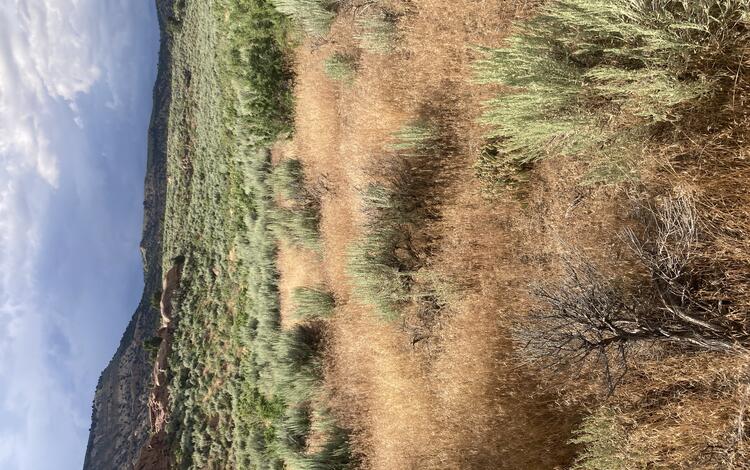
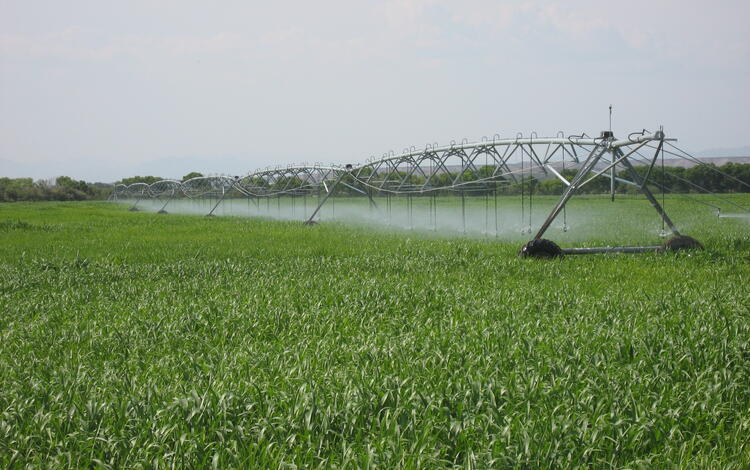
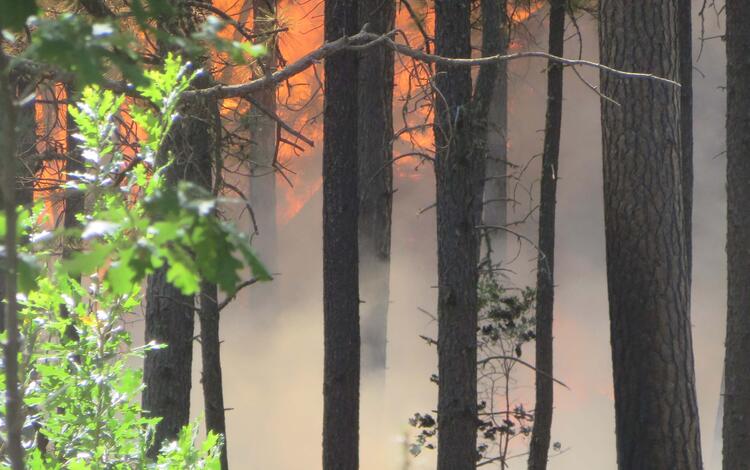
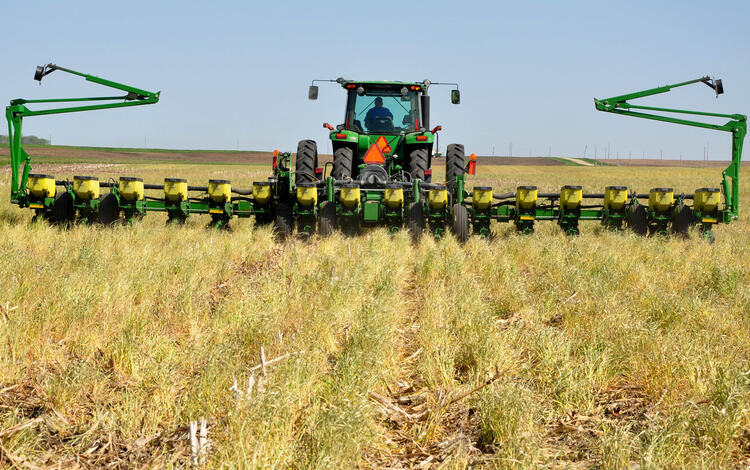

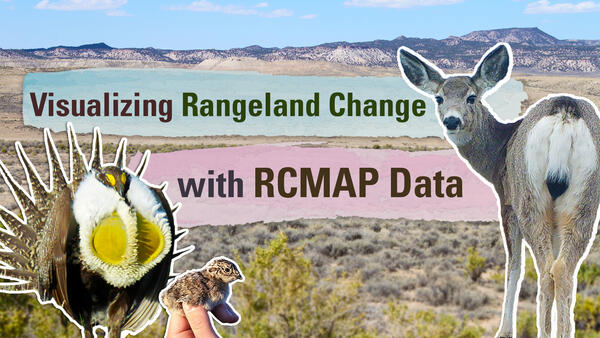
Rangeland managers need information on the current vegetation condition and how the landscape has changed through time. To address this need, scientists from the USGS and Bureau of Land Management (BLM) developed the Rangeland Condition Monitoring Assessment and Projection (RCMAP) project. These data classify western U.S.
Satellite Data and Science Abound in 2025
Serving Society: Annual NLCD Update, Rangeland Maps, Wildland Fire Info and More
The USGS Earth Resources Observation and Science (EROS) Center scientists’ work helps save lives and protect property while EROS offers remote sensing data to the world.
As the Earth begins its next revolution around the sun, let’s look back at some of the exciting accomplishments at EROS in 2025!
Annual NLCD Advancements
A longtime, significant effort at EROS has involved classifying land cover across the United States in the National Land Cover Database (NLCD), a Landsat-based resource widely used by researchers, all levels of government agencies, companies and nonprofit organizations.
In June 2025, just eight months after its debut, the Annual NLCD team at EROS released Collection 1.1, adding land cover and land change information for 2024. This update built on the October 2024 reinvention of NLCD, when Collection 1.0 was introduced, which provided annual land cover and land change data for 1985-2023 across the lower 48 states.
The release of Annual NLCD Collection 1.0 reference and validation data followed in July. This information evaluates the dataset’s accuracy and includes 8,360 reference plots that were reviewed and classified for every year between 1984 and 2023.
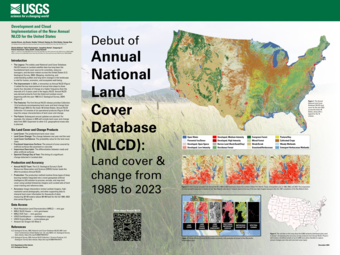
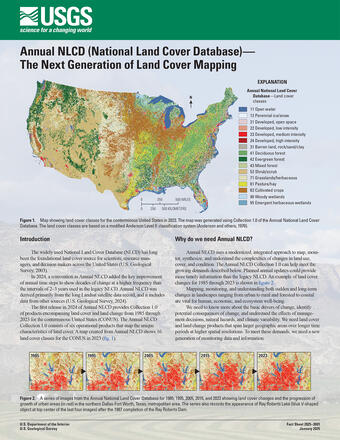
To help explain the vast improvements in USGS’ Annual NLCD to the user community and the public, a new poster was revealed at scientific conferences in 2025, and a new fact sheet was distributed.
Coming in 2026: Annual NLCD Collection 1.2, which will contain land cover and land change information from 2025, is planned for release.
Check out Annual NLCD FAQs
Subscribe to USGS Land Cover Newsletter
More Data Where that Came From
One remarkable project at EROS began in January and concluded in October 2025: processing of the entire ASTER (Advanced Spaceborne Thermal Emission and Reflection Radiometer) archive for NASA’s Land Processes Distributed Active Archive Center (LP DAAC), which is a partnership with the USGS at EROS. The data is now all available in the cloud, with no need to order processing for specific imagery. Processing 25 years’ worth of imagery was expected to take 18 months, but the LP DAAC was able to complete it in far less time.
In addition, EROS staff were involved with more than 25 data releases in 2025, more than one every other week—and that’s not even counting updates to previous releases like Annual NLCD.
EROS scientists who work to classify more specific land cover in the western United States, including sagebrush habitat and exotic annual grasses, released data ranging from springtime weekly exotic annual grass estimates to a 40-year dataset of rangeland land cover components. Data like this helps inform land and fire management decisions.
Other work at EROS helps with agriculture, water management and drought monitoring by estimating evapotranspiration levels, which is the amount of water lost to evaporation and plant transpiration, or plant “sweating.” A 20-year monthly record of evapotranspiration data for the lower 48 states was released in 2025.
EROS scientists contribute to fire-related releases such as the interagency wildland fire management data program’s LANDFIRE annual landscape data updates and the Burn Severity Portal’s fire data updates.
Numerous releases also addressed improvements with Landsat and other remote sensing data, both in accuracy and Landsat product development.
Spread the Word
In 2025, EROS staff released more than 40 publications, including journal articles and reports. Similar to data releases, the topics span land characterization, evapotranspiration estimates and accuracy in remote sensing science, among others.
One publication, “Thirty Years of the U.S. National Land Cover Database: Impacts and Future Direction,” was named the Editor’s Choice Article in the October 2025 issue of Photogrammetric Engineering & Remote Sensing (PE&RS).
In addition, the EROS website published many news articles, including a series called “Landsat at Work” that spotlights ways Landsat data benefits people through a wide variety of commercial uses. From planning transmission paths for emergency communications to keeping an eye on water usage in irrigation, Landsat plays a vital role in all of our lives, livelihoods and resources.
Listen and Learn
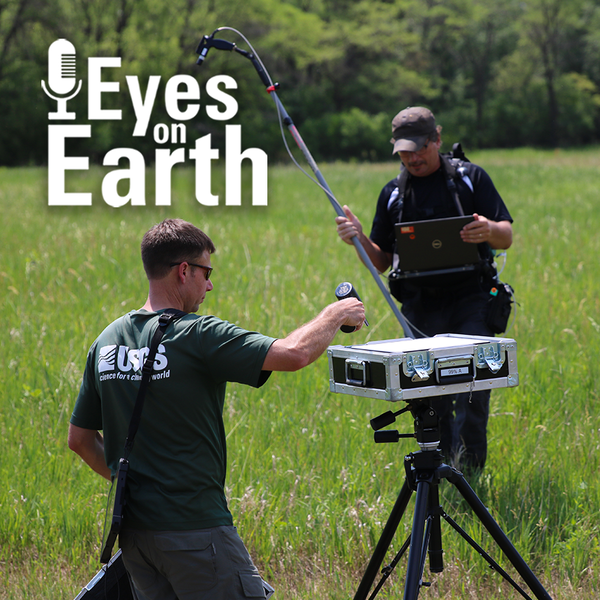
Eyes on Earth podcast episodes produced at EROS covered a wide variety of remote sensing topics in 2025. For example, a two-part series outlined ways EROS has used artificial intelligence (AI) to deliver better scientific results more efficiently, and how AI could improve the future. Another episode spotlighted the value of Landsat thermal data in monitoring Yellowstone National Park.
New Views
Videos and social posts produced at EROS help explain elements of our world through a remote sensing lens. For example, an Image of the Week video included Landsat scenes capturing the adventures of the world’s largest iceberg, A23a. A new Rangeland Condition Monitoring Assessment and Project (RCMAP) video describes the importance of a long-term perspective on rangeland conditions for land managers and researchers.
Among the most popular social posts of the year for the EROS Facebook account was a May 15 post about Las Vegas’ birthday. For EROS Instagram, a May 18 post remembering Mount St. Helens’ eruption 45 years before drew attention. And proving popular on the EROS X account was a July 2 post announcing the Annual NLCD 1.1 release.
If you're not already connected with us on social media, please check out our accounts above.
Related
Land Processes Distributed Active Archive Center
Rangeland Condition Monitoring, Assessment, and Projection (RCMAP)
Annual National Land Cover Database
Rangeland managers need information on the current vegetation condition and how the landscape has changed through time. To address this need, scientists from the USGS and Bureau of Land Management (BLM) developed the Rangeland Condition Monitoring Assessment and Projection (RCMAP) project. These data classify western U.S.
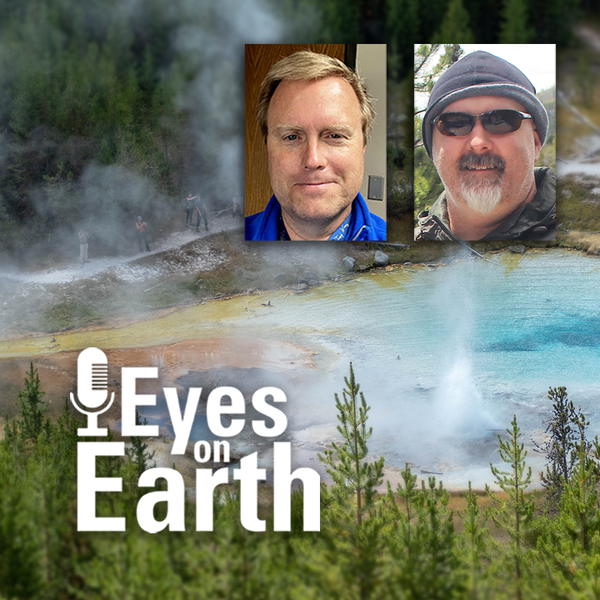
Eyes on Earth Episode 137 – Landsat Takes Yellowstone’s Temperature
Eyes on Earth Episode 137 – Landsat Takes Yellowstone’s TemperatureThe Yellowstone National Park area has more than 10,000 thermal features. And while Old Faithful is a pretty predictable geyser, some thermal features can change quite a bit. New ones can even pop up! Remote sensing provides a tool for monitoring them—especially the thermal infrared sensors (TIRS) on Landsat 8 and Landsat 9 satellites.
Eyes on Earth Episode 137 – Landsat Takes Yellowstone’s Temperature
Eyes on Earth Episode 137 – Landsat Takes Yellowstone’s TemperatureThe Yellowstone National Park area has more than 10,000 thermal features. And while Old Faithful is a pretty predictable geyser, some thermal features can change quite a bit. New ones can even pop up! Remote sensing provides a tool for monitoring them—especially the thermal infrared sensors (TIRS) on Landsat 8 and Landsat 9 satellites.
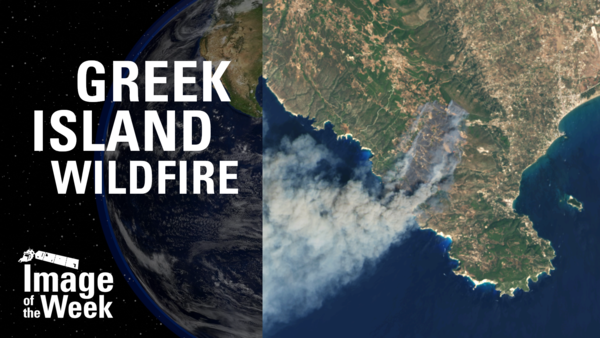
Thumbnail for "Greek Island Wildfire (Image of the Week)" video
Greek firefighters battled a wildfire on the Greek island of Zakynthos in August 2025, one of many late summer fires in the Ionian Islands. Landsat 8 captured smoke, ash, burn scar, and thermal perimeter activity on August 12 in natural color and false color infrared.
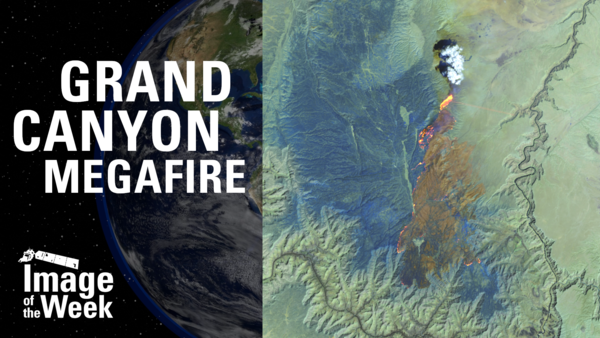
Multiple Landsat passes have captured the growth of the Dragon Bravo Fire in Kaibab National Forest near the North Rim of the Grand Canyon in Arizona.
On July 13, it destroyed the historic Grand Canyon Lodge. Dozens of other buildings have also been destroyed. As of August 15, the fire is 56% contained.
Multiple Landsat passes have captured the growth of the Dragon Bravo Fire in Kaibab National Forest near the North Rim of the Grand Canyon in Arizona.
On July 13, it destroyed the historic Grand Canyon Lodge. Dozens of other buildings have also been destroyed. As of August 15, the fire is 56% contained.
Thumbnail Image for video: "Record-Breaking Flooding in Australia (Image of the Week)"
Record-Breaking Flooding in Australia (Image of the Week)
Record-Breaking Flooding in Australia (Image of the Week)In May 2025, record rainfall in Australia's New South Wales created major flooding along the coast. In Taree, a mid-North Coast city, the Manning River reached a height of 6.4m on May 21st. The previous record of six meters was set back in 1929. The torrential rains have left almost 800 properties and counting uninhabitable in New South Wales.
Record-Breaking Flooding in Australia (Image of the Week)
Record-Breaking Flooding in Australia (Image of the Week)In May 2025, record rainfall in Australia's New South Wales created major flooding along the coast. In Taree, a mid-North Coast city, the Manning River reached a height of 6.4m on May 21st. The previous record of six meters was set back in 1929. The torrential rains have left almost 800 properties and counting uninhabitable in New South Wales.
Eyes on Earth Episode 135 – Exotic Annual Grasses and Sheep Grazing
Eyes on Earth Episode 135 – Exotic Annual Grasses and Sheep GrazingExotic annual grasses, or EAGs, are invasive species. They outcompete native grasses. They are extremely flammable. And they are expanding into higher elevations. Targeted sheep grazing is one way to combat these invasive grasses, manage fire risk, and help restore native sagebrush in western states.
Eyes on Earth Episode 135 – Exotic Annual Grasses and Sheep Grazing
Eyes on Earth Episode 135 – Exotic Annual Grasses and Sheep GrazingExotic annual grasses, or EAGs, are invasive species. They outcompete native grasses. They are extremely flammable. And they are expanding into higher elevations. Targeted sheep grazing is one way to combat these invasive grasses, manage fire risk, and help restore native sagebrush in western states.
Thumbnail for Image of the Week video, "Great Lakes Shipping Season Begins"
Great Lakes Shipping Season Begins (Image of the Week)
Great Lakes Shipping Season Begins (Image of the Week)The St. Marys River between Michigan and Ontario is typically frozen January through March. The US Army Corp of Engineers performs maintenance on regulated access channels (the Soo Locks) during the coldest months.
Great Lakes Shipping Season Begins (Image of the Week)
Great Lakes Shipping Season Begins (Image of the Week)The St. Marys River between Michigan and Ontario is typically frozen January through March. The US Army Corp of Engineers performs maintenance on regulated access channels (the Soo Locks) during the coldest months.
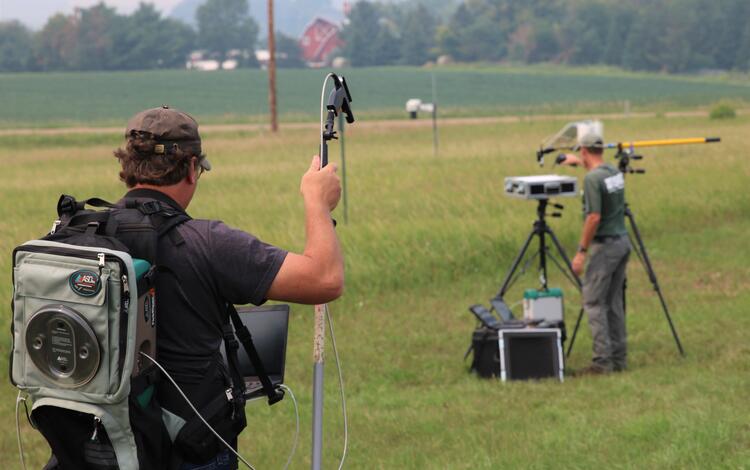
Landsat has been accurate and reliable for over 50 years because of the diligent calibration and validation work done by the team at EROS. One of the ways the team validates what they have so carefully calibrated is to take measurements on the ground while Landsat passes by overhead.
Eyes on Earth Episode 134 – Data Accuracy: The Calibration and Validation of Landsat
Eyes on Earth Episode 134 – Data Accuracy: The Calibration and Validation of LandsatLandsat is the longest-running, continuously operating record of Earth observations, and it’s the gold standard reference point that other civil and commercial satellite programs trust.
Eyes on Earth Episode 134 – Data Accuracy: The Calibration and Validation of Landsat
Eyes on Earth Episode 134 – Data Accuracy: The Calibration and Validation of LandsatLandsat is the longest-running, continuously operating record of Earth observations, and it’s the gold standard reference point that other civil and commercial satellite programs trust.
Eyes on Earth Episode 133 – Vietnam War Bomb Craters
Eyes on Earth Episode 133 – Vietnam War Bomb CratersDeclassified spy satellite imagery, distributed by the USGS EROS Center, is finding fascinating uses since being made available to the public starting in the 1990s.
Eyes on Earth Episode 133 – Vietnam War Bomb Craters
Eyes on Earth Episode 133 – Vietnam War Bomb CratersDeclassified spy satellite imagery, distributed by the USGS EROS Center, is finding fascinating uses since being made available to the public starting in the 1990s.
Eyes on Earth Episode 131 – Using AI in Geospatial Work
Eyes on Earth Episode 131 – Using AI in Geospatial WorkEyes on Earth tackles artificial intelligence (AI) in a 2-part episode. AI is quickly becoming a necessary part of geospatial work at EROS, helping us efficiently do science to better manage our world. In Part 1, EROS Director Pete Doucette discusses AI and its current and upcoming impact on our work at EROS.
Eyes on Earth Episode 131 – Using AI in Geospatial Work
Eyes on Earth Episode 131 – Using AI in Geospatial WorkEyes on Earth tackles artificial intelligence (AI) in a 2-part episode. AI is quickly becoming a necessary part of geospatial work at EROS, helping us efficiently do science to better manage our world. In Part 1, EROS Director Pete Doucette discusses AI and its current and upcoming impact on our work at EROS.
Eyes on Earth Episode 132 - Moving Forward with AI at EROS
Eyes on Earth Episode 132 - Moving Forward with AI at EROSEyes on Earth tackles artificial intelligence (AI) in a 2-part episode. AI is quickly becoming a necessary part of geospatial work at EROS, helping us efficiently do science to better manage our world. In Part 1, we talked about AI’s current and upcoming impact on our work at EROS and clarified some of the AI jargon.
Eyes on Earth Episode 132 - Moving Forward with AI at EROS
Eyes on Earth Episode 132 - Moving Forward with AI at EROSEyes on Earth tackles artificial intelligence (AI) in a 2-part episode. AI is quickly becoming a necessary part of geospatial work at EROS, helping us efficiently do science to better manage our world. In Part 1, we talked about AI’s current and upcoming impact on our work at EROS and clarified some of the AI jargon.
The world’s largest iceberg floats freely in the Southern Ocean.
Iceberg A23a is a 1,500 square mile ice mass larger than the state of Rhode Island. A23a weighs approximately 1 trillion tons and measures around 1,300 feet thick.
The world’s largest iceberg floats freely in the Southern Ocean.
Iceberg A23a is a 1,500 square mile ice mass larger than the state of Rhode Island. A23a weighs approximately 1 trillion tons and measures around 1,300 feet thick.
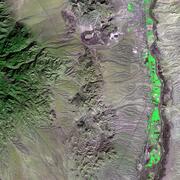
The USGS EROS Landsat archive recently reached a milestone of 12 million Landsat Collection 2 Level-1 products. These are available for download at no charge. The image representing this milestone displays a sprawling desert landscape and contains a multitude of agricultural, geological, and urban features.
Every pixel has a story. At least that’s how land remote sensing scientist Jo Horton sees it. The new Annual National Land Cover Database (NLCD) was just released in October 2024. NLCD is widely used for land cover and change research in the U.S.
Related
Land Processes Distributed Active Archive Center
Rangeland Condition Monitoring, Assessment, and Projection (RCMAP)
Annual National Land Cover Database
Rangeland managers need information on the current vegetation condition and how the landscape has changed through time. To address this need, scientists from the USGS and Bureau of Land Management (BLM) developed the Rangeland Condition Monitoring Assessment and Projection (RCMAP) project. These data classify western U.S.
Eyes on Earth Episode 137 – Landsat Takes Yellowstone’s Temperature
Eyes on Earth Episode 137 – Landsat Takes Yellowstone’s TemperatureThe Yellowstone National Park area has more than 10,000 thermal features. And while Old Faithful is a pretty predictable geyser, some thermal features can change quite a bit. New ones can even pop up! Remote sensing provides a tool for monitoring them—especially the thermal infrared sensors (TIRS) on Landsat 8 and Landsat 9 satellites.
Eyes on Earth Episode 137 – Landsat Takes Yellowstone’s Temperature
Eyes on Earth Episode 137 – Landsat Takes Yellowstone’s TemperatureThe Yellowstone National Park area has more than 10,000 thermal features. And while Old Faithful is a pretty predictable geyser, some thermal features can change quite a bit. New ones can even pop up! Remote sensing provides a tool for monitoring them—especially the thermal infrared sensors (TIRS) on Landsat 8 and Landsat 9 satellites.
Thumbnail for "Greek Island Wildfire (Image of the Week)" video
Greek firefighters battled a wildfire on the Greek island of Zakynthos in August 2025, one of many late summer fires in the Ionian Islands. Landsat 8 captured smoke, ash, burn scar, and thermal perimeter activity on August 12 in natural color and false color infrared.
Multiple Landsat passes have captured the growth of the Dragon Bravo Fire in Kaibab National Forest near the North Rim of the Grand Canyon in Arizona.
On July 13, it destroyed the historic Grand Canyon Lodge. Dozens of other buildings have also been destroyed. As of August 15, the fire is 56% contained.
Multiple Landsat passes have captured the growth of the Dragon Bravo Fire in Kaibab National Forest near the North Rim of the Grand Canyon in Arizona.
On July 13, it destroyed the historic Grand Canyon Lodge. Dozens of other buildings have also been destroyed. As of August 15, the fire is 56% contained.
Thumbnail Image for video: "Record-Breaking Flooding in Australia (Image of the Week)"
Record-Breaking Flooding in Australia (Image of the Week)
Record-Breaking Flooding in Australia (Image of the Week)In May 2025, record rainfall in Australia's New South Wales created major flooding along the coast. In Taree, a mid-North Coast city, the Manning River reached a height of 6.4m on May 21st. The previous record of six meters was set back in 1929. The torrential rains have left almost 800 properties and counting uninhabitable in New South Wales.
Record-Breaking Flooding in Australia (Image of the Week)
Record-Breaking Flooding in Australia (Image of the Week)In May 2025, record rainfall in Australia's New South Wales created major flooding along the coast. In Taree, a mid-North Coast city, the Manning River reached a height of 6.4m on May 21st. The previous record of six meters was set back in 1929. The torrential rains have left almost 800 properties and counting uninhabitable in New South Wales.
Eyes on Earth Episode 135 – Exotic Annual Grasses and Sheep Grazing
Eyes on Earth Episode 135 – Exotic Annual Grasses and Sheep GrazingExotic annual grasses, or EAGs, are invasive species. They outcompete native grasses. They are extremely flammable. And they are expanding into higher elevations. Targeted sheep grazing is one way to combat these invasive grasses, manage fire risk, and help restore native sagebrush in western states.
Eyes on Earth Episode 135 – Exotic Annual Grasses and Sheep Grazing
Eyes on Earth Episode 135 – Exotic Annual Grasses and Sheep GrazingExotic annual grasses, or EAGs, are invasive species. They outcompete native grasses. They are extremely flammable. And they are expanding into higher elevations. Targeted sheep grazing is one way to combat these invasive grasses, manage fire risk, and help restore native sagebrush in western states.
Thumbnail for Image of the Week video, "Great Lakes Shipping Season Begins"
Great Lakes Shipping Season Begins (Image of the Week)
Great Lakes Shipping Season Begins (Image of the Week)The St. Marys River between Michigan and Ontario is typically frozen January through March. The US Army Corp of Engineers performs maintenance on regulated access channels (the Soo Locks) during the coldest months.
Great Lakes Shipping Season Begins (Image of the Week)
Great Lakes Shipping Season Begins (Image of the Week)The St. Marys River between Michigan and Ontario is typically frozen January through March. The US Army Corp of Engineers performs maintenance on regulated access channels (the Soo Locks) during the coldest months.
Landsat has been accurate and reliable for over 50 years because of the diligent calibration and validation work done by the team at EROS. One of the ways the team validates what they have so carefully calibrated is to take measurements on the ground while Landsat passes by overhead.
Eyes on Earth Episode 134 – Data Accuracy: The Calibration and Validation of Landsat
Eyes on Earth Episode 134 – Data Accuracy: The Calibration and Validation of LandsatLandsat is the longest-running, continuously operating record of Earth observations, and it’s the gold standard reference point that other civil and commercial satellite programs trust.
Eyes on Earth Episode 134 – Data Accuracy: The Calibration and Validation of Landsat
Eyes on Earth Episode 134 – Data Accuracy: The Calibration and Validation of LandsatLandsat is the longest-running, continuously operating record of Earth observations, and it’s the gold standard reference point that other civil and commercial satellite programs trust.
Eyes on Earth Episode 133 – Vietnam War Bomb Craters
Eyes on Earth Episode 133 – Vietnam War Bomb CratersDeclassified spy satellite imagery, distributed by the USGS EROS Center, is finding fascinating uses since being made available to the public starting in the 1990s.
Eyes on Earth Episode 133 – Vietnam War Bomb Craters
Eyes on Earth Episode 133 – Vietnam War Bomb CratersDeclassified spy satellite imagery, distributed by the USGS EROS Center, is finding fascinating uses since being made available to the public starting in the 1990s.
Eyes on Earth Episode 131 – Using AI in Geospatial Work
Eyes on Earth Episode 131 – Using AI in Geospatial WorkEyes on Earth tackles artificial intelligence (AI) in a 2-part episode. AI is quickly becoming a necessary part of geospatial work at EROS, helping us efficiently do science to better manage our world. In Part 1, EROS Director Pete Doucette discusses AI and its current and upcoming impact on our work at EROS.
Eyes on Earth Episode 131 – Using AI in Geospatial Work
Eyes on Earth Episode 131 – Using AI in Geospatial WorkEyes on Earth tackles artificial intelligence (AI) in a 2-part episode. AI is quickly becoming a necessary part of geospatial work at EROS, helping us efficiently do science to better manage our world. In Part 1, EROS Director Pete Doucette discusses AI and its current and upcoming impact on our work at EROS.
Eyes on Earth Episode 132 - Moving Forward with AI at EROS
Eyes on Earth Episode 132 - Moving Forward with AI at EROSEyes on Earth tackles artificial intelligence (AI) in a 2-part episode. AI is quickly becoming a necessary part of geospatial work at EROS, helping us efficiently do science to better manage our world. In Part 1, we talked about AI’s current and upcoming impact on our work at EROS and clarified some of the AI jargon.
Eyes on Earth Episode 132 - Moving Forward with AI at EROS
Eyes on Earth Episode 132 - Moving Forward with AI at EROSEyes on Earth tackles artificial intelligence (AI) in a 2-part episode. AI is quickly becoming a necessary part of geospatial work at EROS, helping us efficiently do science to better manage our world. In Part 1, we talked about AI’s current and upcoming impact on our work at EROS and clarified some of the AI jargon.
The world’s largest iceberg floats freely in the Southern Ocean.
Iceberg A23a is a 1,500 square mile ice mass larger than the state of Rhode Island. A23a weighs approximately 1 trillion tons and measures around 1,300 feet thick.
The world’s largest iceberg floats freely in the Southern Ocean.
Iceberg A23a is a 1,500 square mile ice mass larger than the state of Rhode Island. A23a weighs approximately 1 trillion tons and measures around 1,300 feet thick.
The USGS EROS Landsat archive recently reached a milestone of 12 million Landsat Collection 2 Level-1 products. These are available for download at no charge. The image representing this milestone displays a sprawling desert landscape and contains a multitude of agricultural, geological, and urban features.
Every pixel has a story. At least that’s how land remote sensing scientist Jo Horton sees it. The new Annual National Land Cover Database (NLCD) was just released in October 2024. NLCD is widely used for land cover and change research in the U.S.