U.S. flag

An official website of the United States government

Images

Images intro.
Filter Total Items: 695
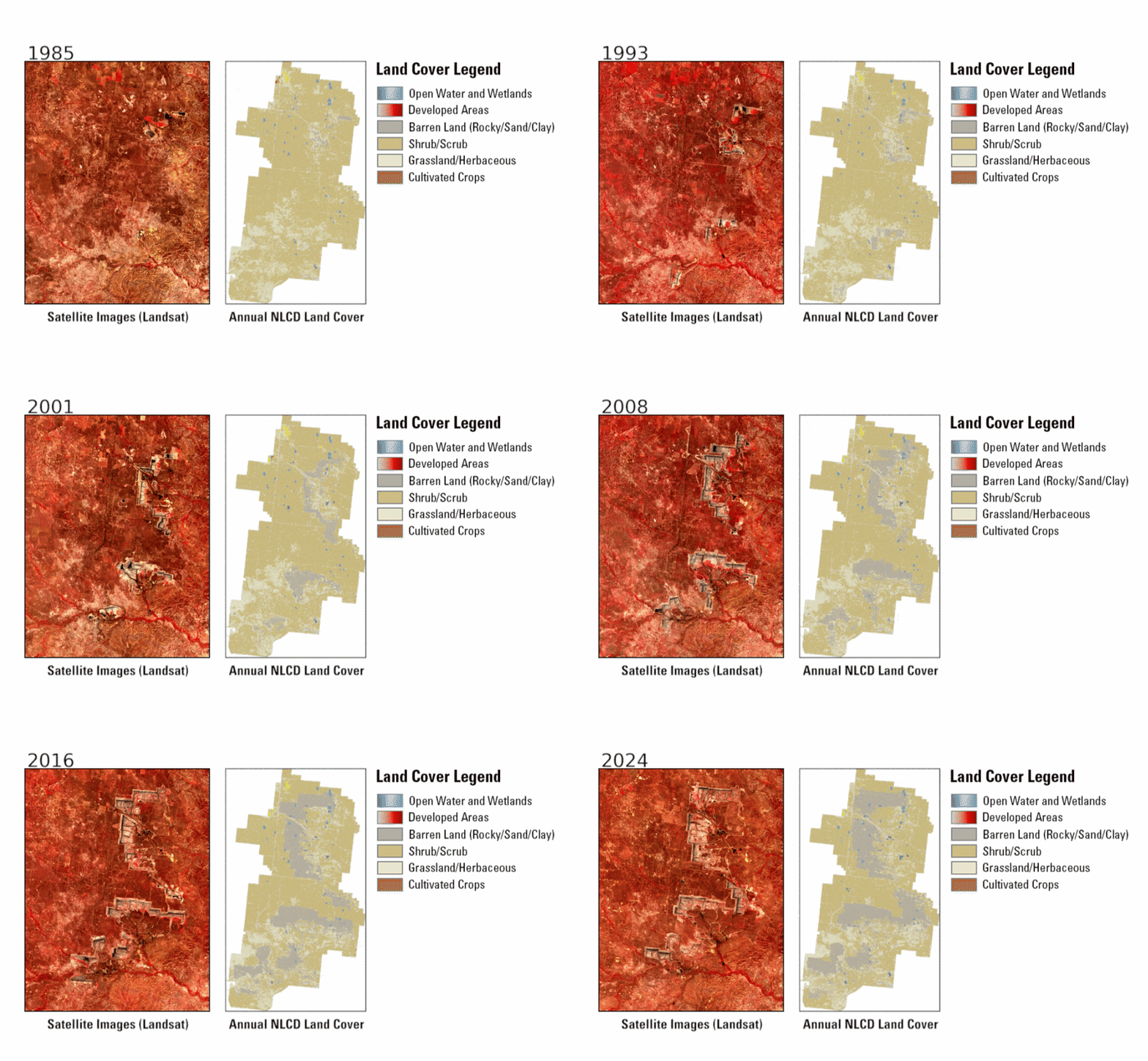
Animations side by side, one showing land and one showing representative colors of land cover types
Landsat and Annual NLCD animations of the Powder River Basin area from 1985 to 2024

Landsat and Annual NLCD animations of the Powder River Basin area in eastern Wyoming from 1985 to 2024 show areas where mining has begun and has shifted over time.

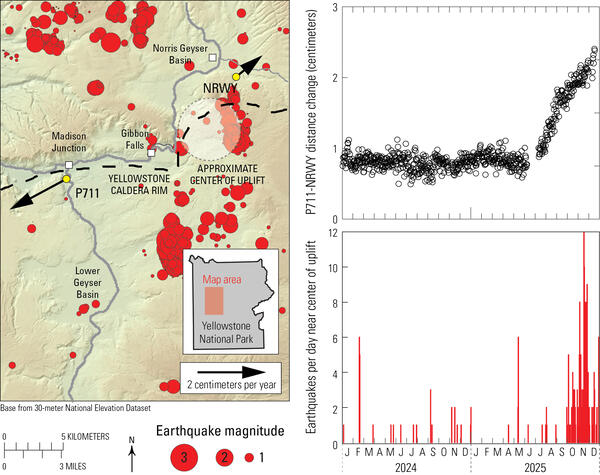
Map of scattered seismicity, deformation showing spreading, and plot showing earthquakes per day near Norris Uplift Anomaly
Deformation and seismicity during 2024-2025 associated with Norris Uplift Anomaly, Yellowstone National Park

Map of horizontal velocities between July and December 2025 at Global Positioning System (GPS) stations P711 and NRWY (arrows and yellow circles; arrow length gives displacement rate) in the area between Norris Geyser Basin and Madison Junction. Dashed black line indicates boundary of Yellowstone Caldera and gray lines are roads.

Map of horizontal velocities between July and December 2025 at Global Positioning System (GPS) stations P711 and NRWY (arrows and yellow circles; arrow length gives displacement rate) in the area between Norris Geyser Basin and Madison Junction. Dashed black line indicates boundary of Yellowstone Caldera and gray lines are roads.

Shaded relief map of Madison Junction area of Yellowstone with arrows showing motion of GPS stations away from uplift source
Horizontal GPS velocities during July-December 2025 in the Madison and Norris areas of Yellowstone National Park

Map of horizontal velocities between July and December 2025 at Global Positioning System (GPS) stations P711 and NRWY (arrows and yellow circles) in the area between Norris Geyser Basin and Madison Junction. Dashed red line indicates boundary of Yellowstone Caldera and gray lines are roads.

Map of Yellowstone caldera's north rim showing uplift and earthquakes located right in the center of the uplift
Map of uplift and earthquakes near Norris Geyser Basin, Yellowstone National Park, during 2024-2025

Map of uplift as seen by interferometric synthetic aperture radar (InSAR) covering the time between October 7, 2024, and October 2, 2025 (the uplift began in July 2025) along the north rim of Yellowstone Caldera to the south of Norris Geyser Basin (NGB). 

column plot showing numbers of earthquakes per day, with increased seismicity in September-December 2025
Plot of daily earthquakes located in the area of the Norris Uplift Anomaly during 2024-2025

Plot of numbers of earthquakes per day in the immediate vicinity of the Norris Uplift Anomaly during 2024-2025.  An increase in the rate of seismicity occurred in September-December 2025, especially in November.  The largest earthquake during that time was M2.7.

Plot of numbers of earthquakes per day in the immediate vicinity of the Norris Uplift Anomaly during 2024-2025.  An increase in the rate of seismicity occurred in September-December 2025, especially in November.  The largest earthquake during that time was M2.7.

earthquakes were scattered throughout the Yellowstone region in 2025, mostly occurring between Hebgen Lake and Norris
Map of Yellowstone seismicity in 2025

Map of seismicity (red circles) in the Yellowstone region during 2025. Gray lines are roads, black dashed line shows the caldera boundary, Yellowstone National Park is outlined by black dot-dashed line, and gray dashed lines denote state boundaries.

Map of seismicity (red circles) in the Yellowstone region during 2025. Gray lines are roads, black dashed line shows the caldera boundary, Yellowstone National Park is outlined by black dot-dashed line, and gray dashed lines denote state boundaries.

The same hot spring shown with lots of sticks and rocks and red in color, and cleaned of debris and clear to gray in color
Hot spring along trail to Grand Prismatic Spring overlook before and after remediation

Hot spring located along the trail to the Grand Prismatic Spring overlook shown before and after the Yellowstone National Park Geology Program team cleaned the feature of sticks and rocks that were thrown in by visitors.  National Park Service photos by Margery Price, July and September 2025,

Hot spring located along the trail to the Grand Prismatic Spring overlook shown before and after the Yellowstone National Park Geology Program team cleaned the feature of sticks and rocks that were thrown in by visitors.  National Park Service photos by Margery Price, July and September 2025,

infographic with pie charts showing hat types and colors, maps showing locations, and logos that were on recovered hats
Infographic with statistics about hats that were recovered from thermal areas in Yellowstone National Park during 2025

Infographic showing the numbers, styles, colors, and other data regarding hats recovered from thermal areas by the Yellowstone National Park Geology Program in 2025.  Designed by Margery Price, Yellowstone National Park.

Map view and cross section with tightly clustered earthquakes depicting fluid-fault interaction in the Yellowstone area
Relocated Yellowstone seismicity recorded during 2008-2022

Map view of relocated Yellowstone seismicity recorded during 2008-2022, colored by time, on the left.  White line gives the outline of Yellowstone caldera. The A-A’ cross section through Yellowstone Lake is shown at the right and illustrates how seismic swarms that are distinct in time relate to one another.  Adapted from Florez and others, 2025 (

Map view of relocated Yellowstone seismicity recorded during 2008-2022, colored by time, on the left.  White line gives the outline of Yellowstone caldera. The A-A’ cross section through Yellowstone Lake is shown at the right and illustrates how seismic swarms that are distinct in time relate to one another.  Adapted from Florez and others, 2025 (

Colorful map of Yellowstone region with bullseyes of color on the north caldera rim and east caldera.
InSAR data from the Yellowstone region spanning October 7, 2024 to October 2, 2025

Interferogram created from satellite radar data collected on October 7, 2024, and October 2, 2025, over the Yellowstone region by the Sentinel-1 satellite system. Colored fringes indicate a change in distance (called range change) between the satellite and ground surface that is caused by surface deformation during the time spanned.

Interferogram created from satellite radar data collected on October 7, 2024, and October 2, 2025, over the Yellowstone region by the Sentinel-1 satellite system. Colored fringes indicate a change in distance (called range change) between the satellite and ground surface that is caused by surface deformation during the time spanned.

looking upslope into a burned watershed with little vegetation and burned trees
Burned watershed in the 2024 Elk Fire burn area

Upstream view of burned hillslopes in the Elk Fire burn area near Dayton, Wyoming. Burned trees, rocks, and rocky outcrops are visible on the slopes.

Upstream view of burned hillslopes in the Elk Fire burn area near Dayton, Wyoming. Burned trees, rocks, and rocky outcrops are visible on the slopes.

mud and rocks on flattened grass
Postfire runoff in the 2024 Elk Fire buran area near Dayton, Wyoming

Postfire runoff in the 2024 Elk Fire buran area near Dayton, Wyoming. Near the outlet of a burned watershed, postfire runoff deposited small boulders and mud, flattening the vegetation in this low-relief area.

Postfire runoff in the 2024 Elk Fire buran area near Dayton, Wyoming. Near the outlet of a burned watershed, postfire runoff deposited small boulders and mud, flattening the vegetation in this low-relief area.

linear deposit of rocks near the edge of a channel that is surrounded by burned trees
Debris-flow levee in the 2024 Elk Fire burn area

Rocks, mud, and woody debris deposited by both flood and debris flow processes are visible in this upstream section of watershed burned by the 2024 Elk Fire near Dayton, Wyoming. The coarser material near the far channel edge was carried by a debris flow while the well-sorted finer material in the foreground has properties associated with flood flow.

Rocks, mud, and woody debris deposited by both flood and debris flow processes are visible in this upstream section of watershed burned by the 2024 Elk Fire near Dayton, Wyoming. The coarser material near the far channel edge was carried by a debris flow while the well-sorted finer material in the foreground has properties associated with flood flow.

gray rock outcrop at the top of of a hillslope that is covered with burned trees
Burned hillslopes in the 2024 Elk Fire burn area near Dayton, Wyoming

A view looking upslope toward the burned hillsides below Dry Fork Ridge in the Bighorn National Forest within the 2024 Elk Fire burn area.

a bile of rocks and mud partially covering a dirt road with mountains visible in the background
Flow deposit in the 2024 Elk Fire burn area

Storm runoff deposited mud, gravel, and small boulders onto Lower Dry Fork Road which runs below the steep watersheds burned by the 2024 Elk Fire near Dayton, Wyoming.

Storm runoff deposited mud, gravel, and small boulders onto Lower Dry Fork Road which runs below the steep watersheds burned by the 2024 Elk Fire near Dayton, Wyoming.

A man and a woman work next to a tower with electronics equipment. Tools are scattered on the grass. Sparse trees behind.
Upgrading the WLWY continuous GPS site in Yellowstone National Park

EarthScope engineers Brendan Hodge (left) and Lia Lajoie (right) perform upgrades at the WLWY (White Lake) continuous GPS station in Yellowstone National Park.  The white box contains the receiver, while the barrel on the ground contains batteries.  The tower holds the solar panels, as well as a cellular modem and meteorological sensors that were recently

EarthScope engineers Brendan Hodge (left) and Lia Lajoie (right) perform upgrades at the WLWY (White Lake) continuous GPS station in Yellowstone National Park.  The white box contains the receiver, while the barrel on the ground contains batteries.  The tower holds the solar panels, as well as a cellular modem and meteorological sensors that were recently

Map of the Upper Colorado River Basin, Integrated Water Availability Assessment.
Map of Upper Colorado River Basin - Integrated Water Availability

Map of the Upper Colorado River Basin —referred to as an Integrated Water Science (IWS) basins—are intensively monitored study basins representing a wide range of environmental, hydrologic, and landscape settings and human stressors of water resources to improve our understanding of water availability across the Nation.

Map of the Upper Colorado River Basin —referred to as an Integrated Water Science (IWS) basins—are intensively monitored study basins representing a wide range of environmental, hydrologic, and landscape settings and human stressors of water resources to improve our understanding of water availability across the Nation.

Hundreds of hats laid out for display with a truck in the background providing a sense of scale
Hats collected by the Yellowstone National Park Geology Program from sensitive thermal areas in 2025

Just some of the hats collected by the Yellowstone National Park Geology Program from sensitive thermal areas throughout the park in 2025.  National Park Service photo by Margery Price, September 3, 2025.

Rock outcrop in the midst of a forest with a person standing on top collecting a sample
USGS geologist collects a sample from a potential newly recognized lava flow along the Gibbon River, Yellowstone National Park
plot showing spikes in temperature due to geyser eruptions over a 6-hour period in August 2025
Temperature record from Valentine and Guardian Geysers, Norris Geyser Basin, Yellowstone National Park, from August 24, 2025

Plot of temperatures measured by continuous loggers at Guardian Geyser (light red) and Valentine Geyser (dark red) on August 24, 2025. Activity at Guardian Geyser included episodic splashing for a few hours prior to the near-simultaneous eruptions of both geysers just after 6:30 a.m. MDT on this date.  Data collected by Mara Reed, Yellowstone National Park.

Plot of temperatures measured by continuous loggers at Guardian Geyser (light red) and Valentine Geyser (dark red) on August 24, 2025. Activity at Guardian Geyser included episodic splashing for a few hours prior to the near-simultaneous eruptions of both geysers just after 6:30 a.m. MDT on this date.  Data collected by Mara Reed, Yellowstone National Park.

Was this page helpful?