U.S. flag

An official website of the United States government

Fish and Wildlife Disease Investigation and Surveillance

At the Eastern Ecological Science Center (EESC), we strive to provide world-class science to inform natural resource decisions that preserve and enhance our quality of life.

Filter Total Items: 95

Identifying Spatial and Temporal Trends in Avian Influenza Prevalence in Wild Waterfowl Across the United States

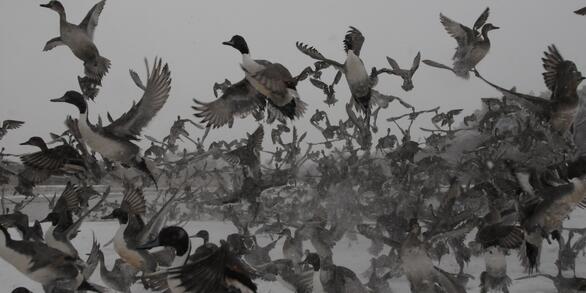
USGS researchers are at the forefront of building and maintaining datasets that represent the spatial and temporal patterns in avian influenza virus prevalence in wild birds, which is critical information used to estimate transmission risk to domestic poultry.
Identifying Spatial and Temporal Trends in Avian Influenza Prevalence in Wild Waterfowl Across the United States

Identifying Spatial and Temporal Trends in Avian Influenza Prevalence in Wild Waterfowl Across the United States

USGS researchers are at the forefront of building and maintaining datasets that represent the spatial and temporal patterns in avian influenza virus prevalence in wild birds, which is critical information used to estimate transmission risk to domestic poultry.
Learn More

Deriving Spatial and Temporal Waterfowl Inputs for Disease Risk Modeling

USGS is creating spatially and temporally explicit inputs to improve avian influenza transmission risk modeling. This project places special emphasis on wild bird distribution and abundance models as well as avian influenza prevalence models.
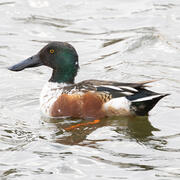
Deriving Spatial and Temporal Waterfowl Inputs for Disease Risk Modeling

Deriving Spatial and Temporal Waterfowl Inputs for Disease Risk Modeling

USGS is creating spatially and temporally explicit inputs to improve avian influenza transmission risk modeling. This project places special emphasis on wild bird distribution and abundance models as well as avian influenza prevalence models.
Learn More

Developing Waterfowl Distribution and Abundance Models to Inform Avian Influenza Transmission Risk

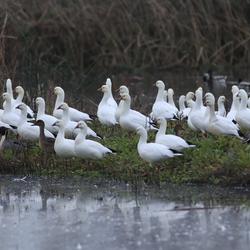
USGS researchers are developing novel methods to improve our understanding of waterfowl distributions and abundance across the United States to inform a variety of ongoing disease studies. Understanding the distribution of wild waterfowl is a critical component to assessing avian influenza transmission risks across the landscape.
Developing Waterfowl Distribution and Abundance Models to Inform Avian Influenza Transmission Risk

Developing Waterfowl Distribution and Abundance Models to Inform Avian Influenza Transmission Risk

USGS researchers are developing novel methods to improve our understanding of waterfowl distributions and abundance across the United States to inform a variety of ongoing disease studies. Understanding the distribution of wild waterfowl is a critical component to assessing avian influenza transmission risks across the landscape.
Learn More

Understanding Avian Influenza Exposure and Antibodies in Understudied Species

Recent outbreaks of highly pathogenic avian influenza have impacted a dramatically wider range of bird hosts than ever before. USGS researchers are working to identify which bird species have been exposed, which have developed immune responses, and how these species may influence viral ecology to inform risk management activities.
Understanding Avian Influenza Exposure and Antibodies in Understudied Species

Understanding Avian Influenza Exposure and Antibodies in Understudied Species

Recent outbreaks of highly pathogenic avian influenza have impacted a dramatically wider range of bird hosts than ever before. USGS researchers are working to identify which bird species have been exposed, which have developed immune responses, and how these species may influence viral ecology to inform risk management activities.
Learn More

Using Telemetry to Understand Overlap in Habitat Use Between Waterfowl and Agricultural Birds in North America

USGS researchers are using telemetry to improve our understanding of how wild birds move throughout their environments and the potential implications for disease transmission within and to domestic poultry.
Using Telemetry to Understand Overlap in Habitat Use Between Waterfowl and Agricultural Birds in North America

Using Telemetry to Understand Overlap in Habitat Use Between Waterfowl and Agricultural Birds in North America

USGS researchers are using telemetry to improve our understanding of how wild birds move throughout their environments and the potential implications for disease transmission within and to domestic poultry.
Learn More

Wings of Change: The Environment's Influence on Bird Flu

Low pathogenic avian influenza (LPAI) viruses naturally occur in wild birds and are rarely fatal. Highly pathogenic avian influenza (HPAI) viruses are highly contagious, spread rapidly, are often fatal to poultry, and have been responsible for worldwide outbreaks. Together, LPAI and HPAI are generally referred to as either avian influenza viruses (AIVs) or "the bird flu."
Wings of Change: The Environment's Influence on Bird Flu

Wings of Change: The Environment's Influence on Bird Flu

Low pathogenic avian influenza (LPAI) viruses naturally occur in wild birds and are rarely fatal. Highly pathogenic avian influenza (HPAI) viruses are highly contagious, spread rapidly, are often fatal to poultry, and have been responsible for worldwide outbreaks. Together, LPAI and HPAI are generally referred to as either avian influenza viruses (AIVs) or "the bird flu."
Learn More

Avian Influenza Dynamics in the Chesapeake Bay Region

This project focuses on understanding the forces driving the risk of avian influenza transmission from wild waterfowl to domestic poultry within the Chesapeake Bay region.
Avian Influenza Dynamics in the Chesapeake Bay Region

Avian Influenza Dynamics in the Chesapeake Bay Region

This project focuses on understanding the forces driving the risk of avian influenza transmission from wild waterfowl to domestic poultry within the Chesapeake Bay region.
Learn More

Understanding Avian Influenza Infection and Movement Behavior of Wild Birds

This project focuses on improving our understanding of how current and previous infection with avian influenza viruses impact the movement ecology of wild bird species.
Understanding Avian Influenza Infection and Movement Behavior of Wild Birds

Understanding Avian Influenza Infection and Movement Behavior of Wild Birds

This project focuses on improving our understanding of how current and previous infection with avian influenza viruses impact the movement ecology of wild bird species.
Learn More

Functional and Molecular Bioassay Core Technology Team

About the Research The Functional and Molecular Bioassay Core Technology Team (CTT) as part of the Environmental Health Program utilizes reporter assays, quantitative gene expression analyses, and high-throughput sequencing methods to produce functional endpoints across a broad scope of environmental topics and sample matrices.
Functional and Molecular Bioassay Core Technology Team

Functional and Molecular Bioassay Core Technology Team

About the Research The Functional and Molecular Bioassay Core Technology Team (CTT) as part of the Environmental Health Program utilizes reporter assays, quantitative gene expression analyses, and high-throughput sequencing methods to produce functional endpoints across a broad scope of environmental topics and sample matrices.
Learn More

AquaDePTH-Aquatic Disease and Pathogen Repository

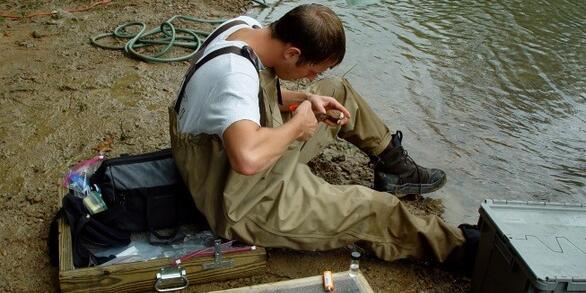
The Aquatic Disease and Pathogen Repository (AquaDePTH) will be a public-facing national repository to support biosurveillance of aquatic animal diseases and pathogens. By collating historically published data, plus new aquatic pathogen and disease information, stakeholders will be able monitor fish kill and aquatic pathogen trends spatially and temporally in freshwater and marine environments...
AquaDePTH-Aquatic Disease and Pathogen Repository

AquaDePTH-Aquatic Disease and Pathogen Repository

The Aquatic Disease and Pathogen Repository (AquaDePTH) will be a public-facing national repository to support biosurveillance of aquatic animal diseases and pathogens. By collating historically published data, plus new aquatic pathogen and disease information, stakeholders will be able monitor fish kill and aquatic pathogen trends spatially and temporally in freshwater and marine environments...
Learn More

Northeast Amphibian Research and Monitoring Initiative

The U.S. Geological Survey’s Eastern Ecological Science Center is home to the Northeast Amphibian Research and Monitoring Initiative (NEARMI), one of 7 ARMI regions across the United States. NEARMI works on public lands in thirteen states from Maine to Virginia, including many National Parks and National Wildlife Refuges.
Northeast Amphibian Research and Monitoring Initiative

Northeast Amphibian Research and Monitoring Initiative

The U.S. Geological Survey’s Eastern Ecological Science Center is home to the Northeast Amphibian Research and Monitoring Initiative (NEARMI), one of 7 ARMI regions across the United States. NEARMI works on public lands in thirteen states from Maine to Virginia, including many National Parks and National Wildlife Refuges.
Learn More
Integrating Science and Management to Assist with the Response to Stony Coral Tissue Loss Disease

Integrating Science and Management to Assist with the Response to Stony Coral Tissue Loss Disease

A USGS multi-disciplinary team will use laboratory and modeling approaches to investigate the cause of stony coral tissue loss disease.
Learn More
Was this page helpful?