



The Operational Land Imager (OLI) onboard Landsat 8 captured this image of Lake Tahoe.
Images
Peruse our selection of remote sensing and Earth science imagery below.
Filter Total Items: 889

Landsat 8 Image of Lake Tahoe
The Operational Land Imager (OLI) onboard Landsat 8 captured this image of Lake Tahoe.

National Land Cover Database of the Cape Cod Region
National Land Cover Database of the Cape Cod RegionThis map of the Cape Cod region is created with the National Land Cover Dataset (NLCD). The dataset classifies land cover into categories such as developed areas, forests, wetlands, and water bodies, providing a detailed view of the region's composition.
National Land Cover Database of the Cape Cod Region
National Land Cover Database of the Cape Cod RegionThis map of the Cape Cod region is created with the National Land Cover Dataset (NLCD). The dataset classifies land cover into categories such as developed areas, forests, wetlands, and water bodies, providing a detailed view of the region's composition.
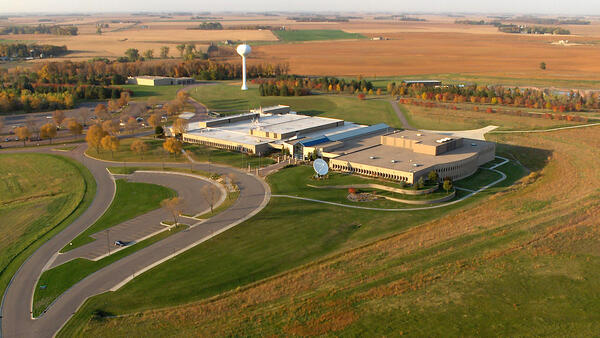
USGS Earth Resources Observation and Science (EROS) Center
USGS Earth Resources Observation and Science (EROS) CenterThe Landsat Ground Station (LGS) is located at the U.S. Geological Survey (USGS) Earth Resources Observation and Science (EROS) Center in Sioux Falls, South Dakota. LGS supports all Landsat missions.
USGS Earth Resources Observation and Science (EROS) Center
USGS Earth Resources Observation and Science (EROS) CenterThe Landsat Ground Station (LGS) is located at the U.S. Geological Survey (USGS) Earth Resources Observation and Science (EROS) Center in Sioux Falls, South Dakota. LGS supports all Landsat missions.

Landsat 9 image of Northern Madagascar
The Betsiboka River in Northern Madagascar is seen in this Landsat 9 natural color image from December 7, 2021. Extensive logging has left the land vulnerable, and iron rich soils are washed into the river, coloring it a reddish orange as it flows to the Betsiboka estuary delta.
Product ID LC09_L1TP_160071_20211207_20220120_02_T1
The Betsiboka River in Northern Madagascar is seen in this Landsat 9 natural color image from December 7, 2021. Extensive logging has left the land vulnerable, and iron rich soils are washed into the river, coloring it a reddish orange as it flows to the Betsiboka estuary delta.
Product ID LC09_L1TP_160071_20211207_20220120_02_T1

Landsat Mission Website Changes
On Tuesday December 7, 2021, updates were made to all USGS webpages, including the Landsat Missions Web Site (LMWS).
Learn more here: https://www.usgs.gov/landsat-missions/news/landsat-mission-web-site-cha…
On Tuesday December 7, 2021, updates were made to all USGS webpages, including the Landsat Missions Web Site (LMWS).
Learn more here: https://www.usgs.gov/landsat-missions/news/landsat-mission-web-site-cha…

Mapping tree height distributions in Sub-Saharan Africa using Landsat 7 and 8 data
Mapping tree height distributions in Sub-Saharan Africa using Landsat 7 and 8 data

Human or natural? Landscape context improves the attribution of forest disturbances mapped from Landsat in Central Europe
Human or natural? Landscape context improves the attribution of forest disturbances mapped from Landsat in Central EuropeDeforestation can happen naturally, through infestation of native beetles and extreme weather. However, people can intentionally clear forests for timber and other industries. Difference between the two can be difficult to diagnose.
Human or natural? Landscape context improves the attribution of forest disturbances mapped from Landsat in Central Europe
Human or natural? Landscape context improves the attribution of forest disturbances mapped from Landsat in Central EuropeDeforestation can happen naturally, through infestation of native beetles and extreme weather. However, people can intentionally clear forests for timber and other industries. Difference between the two can be difficult to diagnose.

Landsat Science Team Meeting Virtually Held
NASA and the USGS briefed the Landsat Science Team about Landsat 9 at their Fall Meeting held virtually on November 24, 2021.
Read the details here: https://www.usgs.gov/landsat-missions/news/landsat-science-team-virtual…
NASA and the USGS briefed the Landsat Science Team about Landsat 9 at their Fall Meeting held virtually on November 24, 2021.
Read the details here: https://www.usgs.gov/landsat-missions/news/landsat-science-team-virtual…

10 Millionth Landsat Image
On November 23, 2021, the Landsat Archive added its ten millionth image. The Landsat 7 scene was acquired over the Dead Sea and is shown as a false color image using the short-wave infrared, near infrared and red bands (bands 5,4,3).
On November 23, 2021, the Landsat Archive added its ten millionth image. The Landsat 7 scene was acquired over the Dead Sea and is shown as a false color image using the short-wave infrared, near infrared and red bands (bands 5,4,3).

Queensland Australia Landsat 8-Landsat 9 Underfly Images
Queensland Australia Landsat 8-Landsat 9 Underfly ImagesThese images of an area in south central Queensland, Australia were acquired by the instruments onboard both Landsat 8 and Landsat 9 on November 15, 2021, as Landsat 9 flew beneath Landsat 8 as the satellite continued its climb to nominal orbital altitude.
Queensland Australia Landsat 8-Landsat 9 Underfly Images
Queensland Australia Landsat 8-Landsat 9 Underfly ImagesThese images of an area in south central Queensland, Australia were acquired by the instruments onboard both Landsat 8 and Landsat 9 on November 15, 2021, as Landsat 9 flew beneath Landsat 8 as the satellite continued its climb to nominal orbital altitude.

Guymon, OK underfly one
Thick vegetation at a Guymon, Oklahoma, site required parking a quarter-mile away. The pickup is visible at the top center of the photo, which was taken on November 11, 2021, the first characterization day there. (Photo by Jeff Irwin, USGS)
Thick vegetation at a Guymon, Oklahoma, site required parking a quarter-mile away. The pickup is visible at the top center of the photo, which was taken on November 11, 2021, the first characterization day there. (Photo by Jeff Irwin, USGS)

Landsat image of Window Rock, Arizona
Landsat image of Window Rock, Arizona, acquired on November 3, 2021.
For more information about Landsat, please visit www.usgs.gov/Landsat
To download the data, visit earthexplorer.usgs.gov
Landsat image of Window Rock, Arizona, acquired on November 3, 2021.
For more information about Landsat, please visit www.usgs.gov/Landsat
To download the data, visit earthexplorer.usgs.gov

C2L2 Factsheet Image
Landsat 5 images of Zhuozhou, China, on September 7, 1999, showing top-of-atmosphere (TOA) reflectance; Level-2 surface reflectance (SR); and Level-2 surface temperature (ST), in Kelvin (K). View fact sheet at Landsat Collection 2 Level-2 Science Products (usgs.gov).
Landsat 5 images of Zhuozhou, China, on September 7, 1999, showing top-of-atmosphere (TOA) reflectance; Level-2 surface reflectance (SR); and Level-2 surface temperature (ST), in Kelvin (K). View fact sheet at Landsat Collection 2 Level-2 Science Products (usgs.gov).

Mangrove deforestation and CO2 emissions in Indonesia
Mangrove deforestation and CO2 emissions in Indonesia

Landsat 9 First Light Image of the Himalayas
The city of Kathmandu, Nepal, seen at the bottom left of this Landsat 9 image, lies in a valley south of the Himalayan Mountainsbetween Nepal and China. Glaciers, and the lakes formed by glacial meltwater, are visible in the top middle of this image.
The city of Kathmandu, Nepal, seen at the bottom left of this Landsat 9 image, lies in a valley south of the Himalayan Mountainsbetween Nepal and China. Glaciers, and the lakes formed by glacial meltwater, are visible in the top middle of this image.

Landsat 9 First Light Detroit & Lake Erie
Sediments swirl in Lake Erie and Lake St. Clair in this Landsat 9 image of both Detroit, Michigan, and Windsor, Ontario, from Oct. 31, 2021. The Great Lakes serve as sources of freshwater, recreational activity, transport, and habitat for the upper-midwestern US, and water quality remains a high priority.
Sediments swirl in Lake Erie and Lake St. Clair in this Landsat 9 image of both Detroit, Michigan, and Windsor, Ontario, from Oct. 31, 2021. The Great Lakes serve as sources of freshwater, recreational activity, transport, and habitat for the upper-midwestern US, and water quality remains a high priority.

Navajo Nation
In the Western U.S., in places like the Navajo Nation as seen in this Landsat 9 image, Landsat and other satellite data help people monitor drought conditions and manage irrigation water. With only 85 rain gauges to cover more than 27,000 square miles, satellite data and climate models are filling the gaps to help the Navajo Nation monitor drought severity.
In the Western U.S., in places like the Navajo Nation as seen in this Landsat 9 image, Landsat and other satellite data help people monitor drought conditions and manage irrigation water. With only 85 rain gauges to cover more than 27,000 square miles, satellite data and climate models are filling the gaps to help the Navajo Nation monitor drought severity.
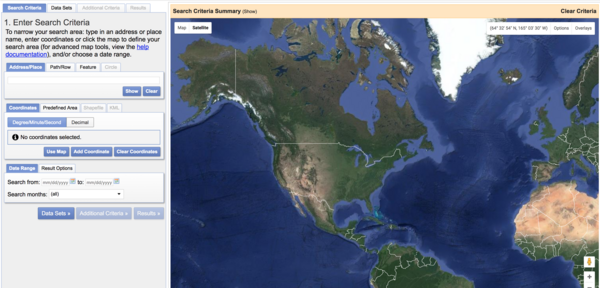
Screenshot — USGS EarthExplorer (EE)
The EarthExplorer (EE) user interface is an online search, discovery, and ordering tool developed by the United States Geological Survey (USGS). EE supports the searching of satellite, aircraft, and other remote sensing inventories through interactive and textual-based query capabilities.
The EarthExplorer (EE) user interface is an online search, discovery, and ordering tool developed by the United States Geological Survey (USGS). EE supports the searching of satellite, aircraft, and other remote sensing inventories through interactive and textual-based query capabilities.

Landsat Image of California Caldor Fire - August 14, 2021
Landsat Image of California Caldor Fire - August 14, 2021The Caldor Fire in California started on August 14, 2021 and quickly spread in high winds. The fire expanded toward the Lake Tahoe area as residents evacuated. Landsat image was captured on August 21, the 8th day. Landsat 8's near-infrared and shortwave infrared bands reveal active fire, burn scars, and smoke.
Landsat Image of California Caldor Fire - August 14, 2021
Landsat Image of California Caldor Fire - August 14, 2021The Caldor Fire in California started on August 14, 2021 and quickly spread in high winds. The fire expanded toward the Lake Tahoe area as residents evacuated. Landsat image was captured on August 21, the 8th day. Landsat 8's near-infrared and shortwave infrared bands reveal active fire, burn scars, and smoke.

Eyes on Earth - Colorado Bark Beetles homepage
From top, Dr. Kyle Rodman, Dr. Zhiliang Zhu, and Dr. Sarah Hart, pictured with the graphic for the USGS EROS podcast "Eyes on Earth."
From top, Dr. Kyle Rodman, Dr. Zhiliang Zhu, and Dr. Sarah Hart, pictured with the graphic for the USGS EROS podcast "Eyes on Earth."

Example of the Landsat Collection 2 Burned Area Science Product showing the Bootleg Fire in Oregon
Example of the Landsat Collection 2 Burned Area Science Product showing the Bootleg Fire in OregonExample of the Landsat Collection 2 Burned Area Science Product showing the Bootleg Fire in Oregon on July 11, 2021 for tile h006V010. Left: Landsat 8 Collection 2 U.S. Analysis Ready Data Surface Reflectance image (Bands 6,5,4), Middle: Burn Classification (BC), and Right: Burn Probability (BP).
Example of the Landsat Collection 2 Burned Area Science Product showing the Bootleg Fire in Oregon
Example of the Landsat Collection 2 Burned Area Science Product showing the Bootleg Fire in OregonExample of the Landsat Collection 2 Burned Area Science Product showing the Bootleg Fire in Oregon on July 11, 2021 for tile h006V010. Left: Landsat 8 Collection 2 U.S. Analysis Ready Data Surface Reflectance image (Bands 6,5,4), Middle: Burn Classification (BC), and Right: Burn Probability (BP).