



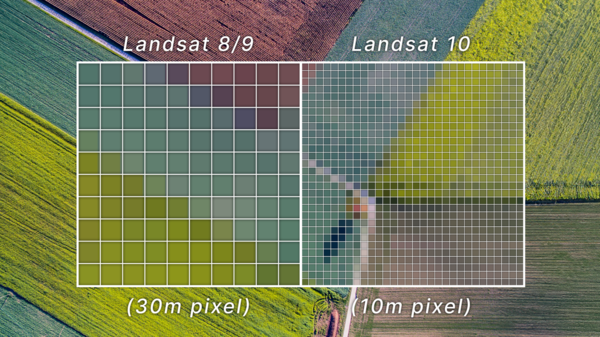
Landsat 10 will collect five foundational spectral bands at 10-meter resolution, compared to the 30-meter resolution used by Landsat 8 and 9. The smaller pixels provide sharper images and support more detailed mapping of Earth's changing landscapes. Image credit: NASA
Images
Explore the images on this page to learn more about the Landsat sensors, satellites and missions.
Filter Total Items: 415
Landsat Spatial Resolution Comparison
Landsat 10 will collect five foundational spectral bands at 10-meter resolution, compared to the 30-meter resolution used by Landsat 8 and 9. The smaller pixels provide sharper images and support more detailed mapping of Earth's changing landscapes. Image credit: NASA

2026-2030 Landsat Science Team
The 2026-2030 Landsat Science Team met for their first in-person meeting May 5-7, 2026 at the USGS EROS Center.
The 2026-2030 Landsat Science Team met for their first in-person meeting May 5-7, 2026 at the USGS EROS Center.
Ice Along the Western Antarctic Coastline
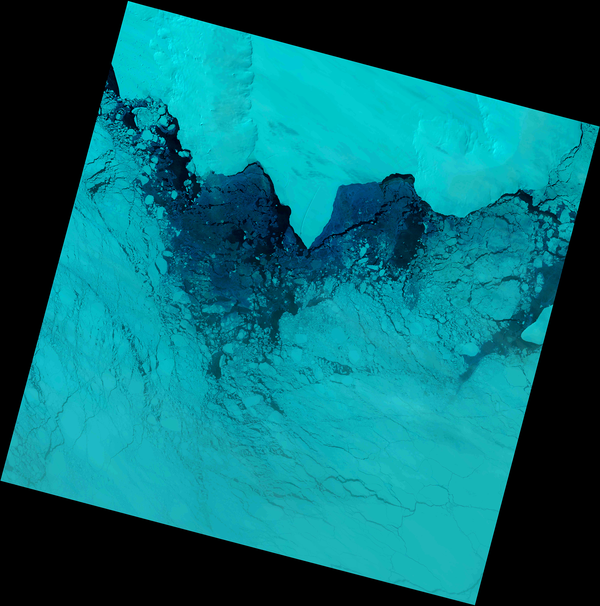
This Landsat 9 image shows ice along a portion of the Antarctic western coast and the Amundsen Sea.
This image was acquired on October 24, 2025, immediately after the Landsat 9 spacecraft recovered from a weeklong safehold event. The data used in this image were processed for the first time in March 2026.
This Landsat 9 image shows ice along a portion of the Antarctic western coast and the Amundsen Sea.
This image was acquired on October 24, 2025, immediately after the Landsat 9 spacecraft recovered from a weeklong safehold event. The data used in this image were processed for the first time in March 2026.
Laramie Mountains, Wyoming
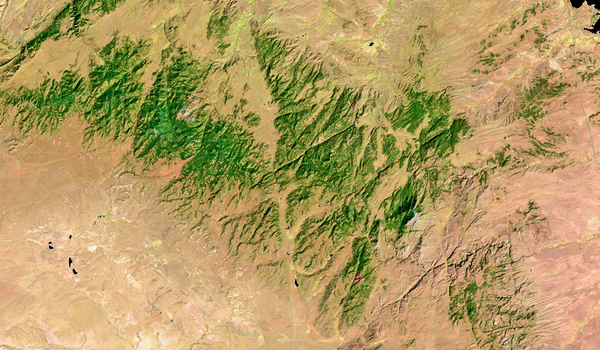
This Landsat image displays a portion of the Laramie Mountains within the Medicine Bow National Forest in southeastern Wyoming. The rugged mountain range marks part of the eastern edge of the Rocky Mountains.
- Landsat 8
- Path 34 Row 31
- Acquired March 29, 2026
This Landsat image displays a portion of the Laramie Mountains within the Medicine Bow National Forest in southeastern Wyoming. The rugged mountain range marks part of the eastern edge of the Rocky Mountains.
- Landsat 8
- Path 34 Row 31
- Acquired March 29, 2026
Landsat 9 Image of McCartney Mountain
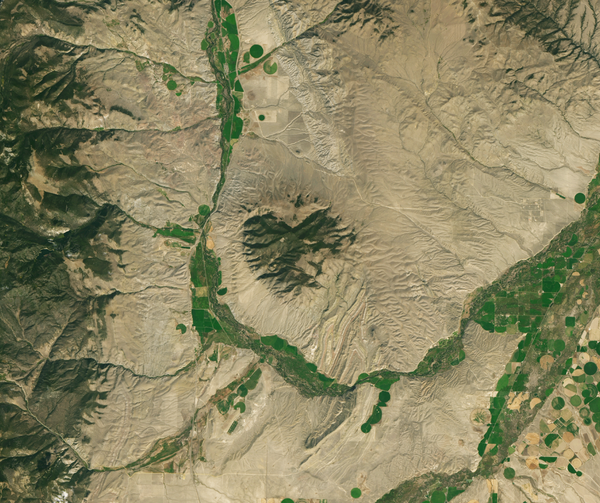
Landsat 9 captured this image of heart-shaped McCartney Mountain on September 20, 2025. At an elevation of over 8,300 feet, the mountain is the high point of a small sub-range of the Highland Mountains in southwestern Montana.
Landsat 9 captured this image of heart-shaped McCartney Mountain on September 20, 2025. At an elevation of over 8,300 feet, the mountain is the high point of a small sub-range of the Highland Mountains in southwestern Montana.
Landsat Citations
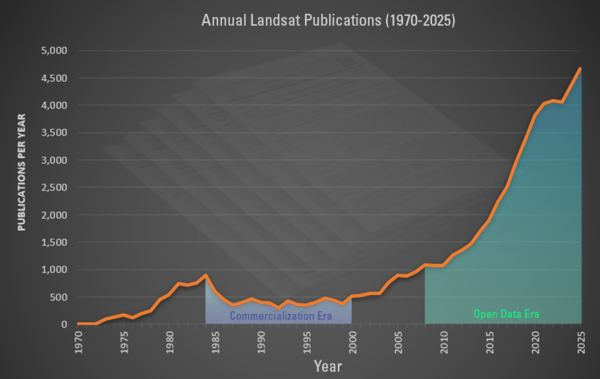
This graphic displays the number of Landsat-related publications starting in 1970. While publications decreased during the Commercialization Era, research rebounded greatly after the USGS open data policy decision in 2008.
This graphic displays the number of Landsat-related publications starting in 1970. While publications decreased during the Commercialization Era, research rebounded greatly after the USGS open data policy decision in 2008.
Landsat Global Archive Consolidation WRS 2 Scenes
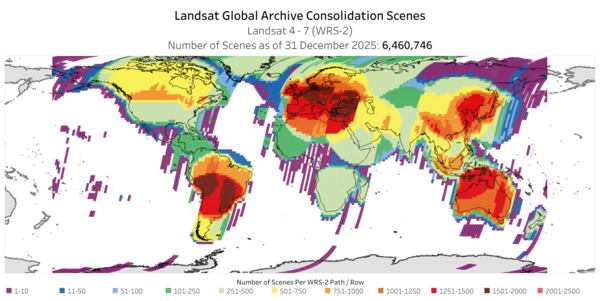
This map displays the scenes acquired by Landsat 4, Landsat 5, and Landsat 7 satellites, on the World Reference System (WRS-2). These scenes were initially downlinked and stored at Landsat International Cooperator Ground Stations.
This map displays the scenes acquired by Landsat 4, Landsat 5, and Landsat 7 satellites, on the World Reference System (WRS-2). These scenes were initially downlinked and stored at Landsat International Cooperator Ground Stations.
Landsat Global Archive Consolidation WRS 1 Scenes
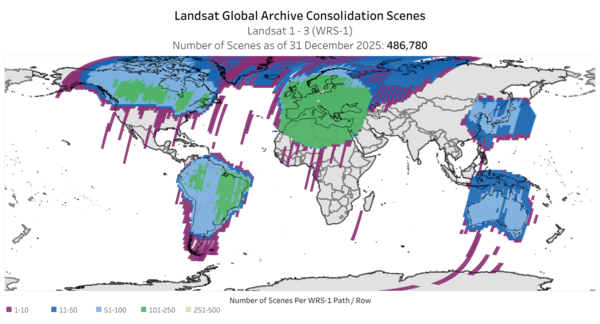
This map displays the scenes acquired by Landsat 1, Landsat 2, and Landsat 3 satellites, on the World Reference System (WRS-1). These scenes were initially downlinked and stored at Landsat International Cooperator Ground Stations.
This map displays the scenes acquired by Landsat 1, Landsat 2, and Landsat 3 satellites, on the World Reference System (WRS-1). These scenes were initially downlinked and stored at Landsat International Cooperator Ground Stations.
Landsat Benefits Webpage Banner
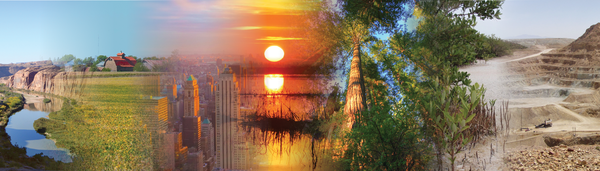
The Landsat Benefits Webpage Banner displays some ways of how Landsat data benefits the United States.
Visit the Landsat Benefits, State by State webpage to see how Landsat benefits your favorite State!
The Landsat Benefits Webpage Banner displays some ways of how Landsat data benefits the United States.
Visit the Landsat Benefits, State by State webpage to see how Landsat benefits your favorite State!
Landsat 4 Mission Infographic
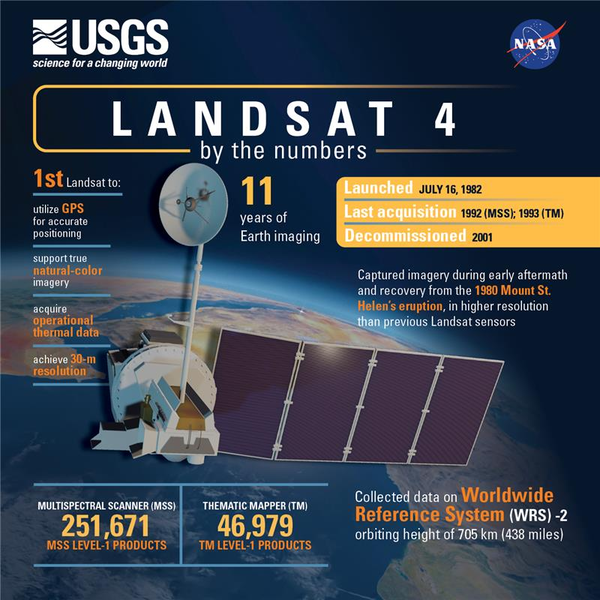
The Landsat 4 satellite was launched July 16, 1982, and ushered in many “firsts” that propelled the Landsat missions that followed.
The Landsat 4 satellite was launched July 16, 1982, and ushered in many “firsts” that propelled the Landsat missions that followed.
Apalachicola River Watershed and Bay
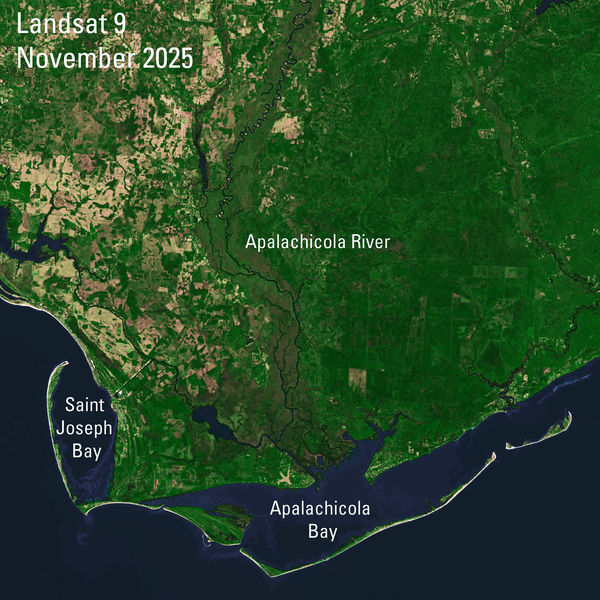
This Landsat 9 image shows the Apalachicola River and the Apalachicola Bay in Florida’s Panhandle. The river —Florida’s largest in terms of water volume discharge— follows the western boundary of heavy forest and is home to great diversity of freshwater fish species.
This Landsat 9 image shows the Apalachicola River and the Apalachicola Bay in Florida’s Panhandle. The river —Florida’s largest in terms of water volume discharge— follows the western boundary of heavy forest and is home to great diversity of freshwater fish species.
Landsat Sees Where the Snow Lands
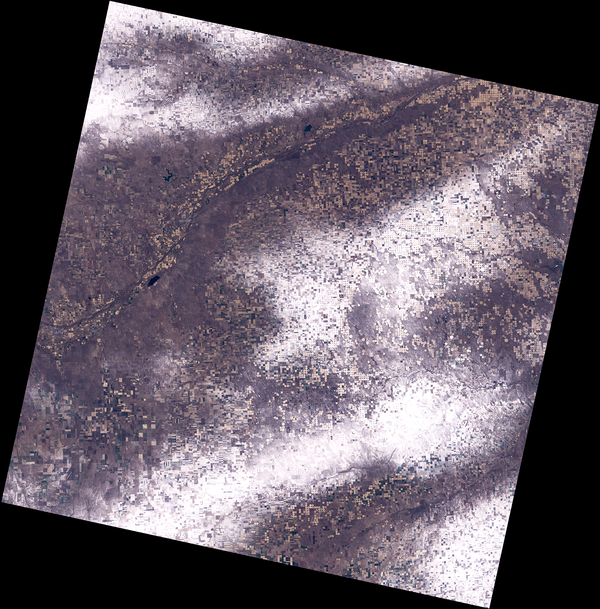
November’s final weekend brought snowfall to much of the northern United States. This Landsat 9 image, acquired on December 1st, highlights an area along the South Platte River near the point where the Missouri, Nebraska, and Colorado borders meet.
November’s final weekend brought snowfall to much of the northern United States. This Landsat 9 image, acquired on December 1st, highlights an area along the South Platte River near the point where the Missouri, Nebraska, and Colorado borders meet.
Las Vegas, 2025
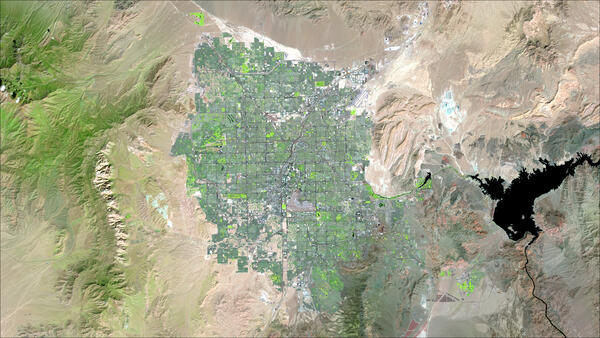
This false-color Landsat 8 image, acquired on September 16, 2025, shows the Las Vegas metropolitan area in southern Nevada. Lake Mead is visible east of the city, while the surrounding Mojave Desert, mountain ranges, and irrigated agricultural areas provide contrast with the urban landscape.
This false-color Landsat 8 image, acquired on September 16, 2025, shows the Las Vegas metropolitan area in southern Nevada. Lake Mead is visible east of the city, while the surrounding Mojave Desert, mountain ranges, and irrigated agricultural areas provide contrast with the urban landscape.

Annual NLCD and Landsat animations of the Boise, Idaho, area
Annual NLCD and Landsat animations of the Boise, Idaho, areaThis animation shows Treasure Valley, part of the Snake River Valley and home to the Boise, Idaho, metro area. The Boise Mountains lie to the east, and cropland and pasture/hay land lie to the west. The area’s population has seen significant growth in recent decades, far more than doubling between 1990 and now to above 800,000.
Annual NLCD and Landsat animations of the Boise, Idaho, area
Annual NLCD and Landsat animations of the Boise, Idaho, areaThis animation shows Treasure Valley, part of the Snake River Valley and home to the Boise, Idaho, metro area. The Boise Mountains lie to the east, and cropland and pasture/hay land lie to the west. The area’s population has seen significant growth in recent decades, far more than doubling between 1990 and now to above 800,000.
Animations (Annual NLCD and Landsat) of the 1992 Fountain Fire in California
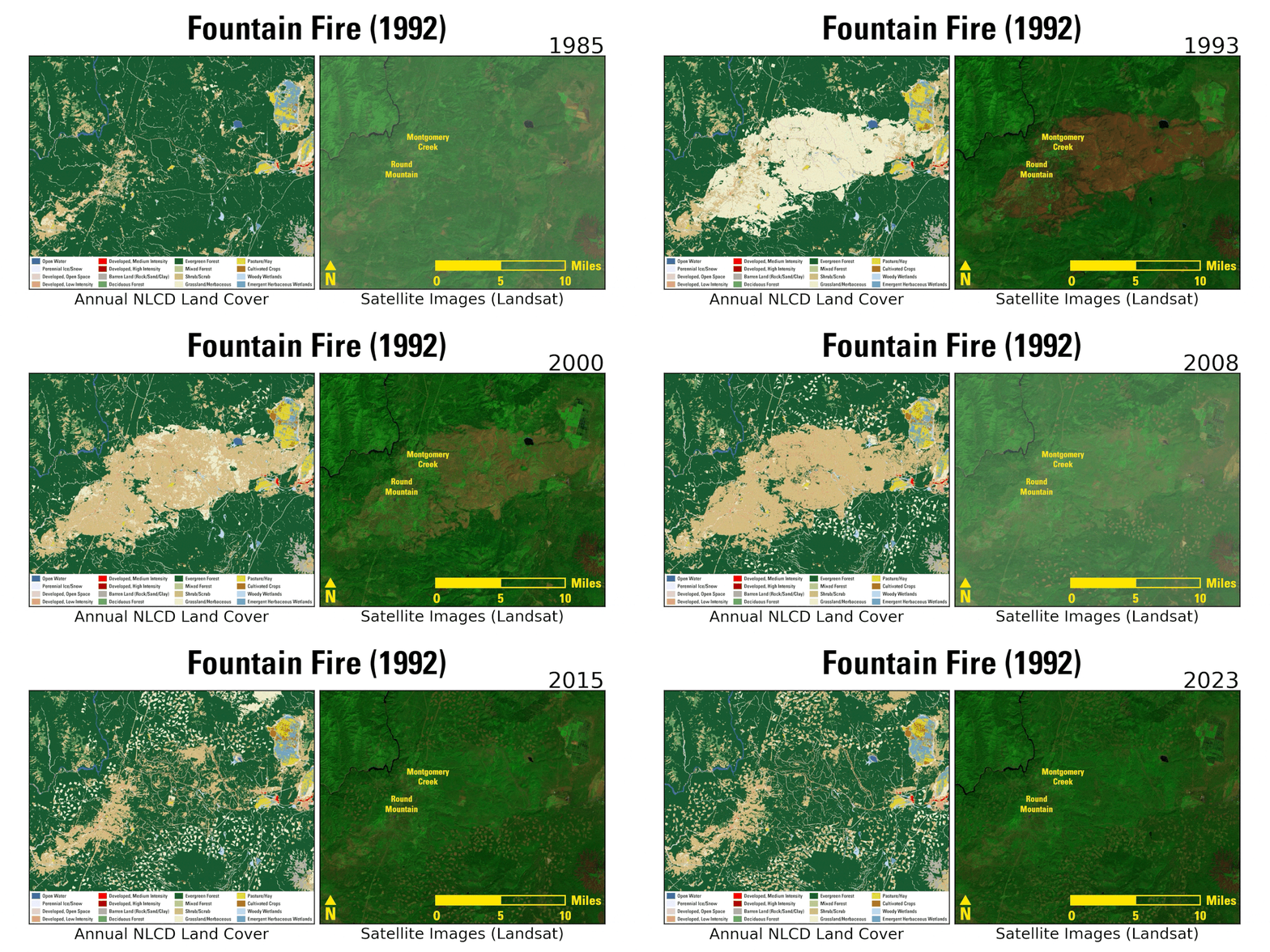
Animations (Annual NLCD and Landsat) of the 1992 Fountain Fire in CaliforniaThis animation shows Annual NLCD land cover data on the left that was derived from Landsat imagery on the right. It illustrates the effects of the 1992 Fountain Fire in northern California and much of the forested area’s eventual recovery. The Fountain Fire burned about 64,000 acres, almost all of it privately owned.
Animations (Annual NLCD and Landsat) of the 1992 Fountain Fire in California
Animations (Annual NLCD and Landsat) of the 1992 Fountain Fire in CaliforniaThis animation shows Annual NLCD land cover data on the left that was derived from Landsat imagery on the right. It illustrates the effects of the 1992 Fountain Fire in northern California and much of the forested area’s eventual recovery. The Fountain Fire burned about 64,000 acres, almost all of it privately owned.
Annual NLCD and Landsat animations of a portion of the Okefenokee Plain
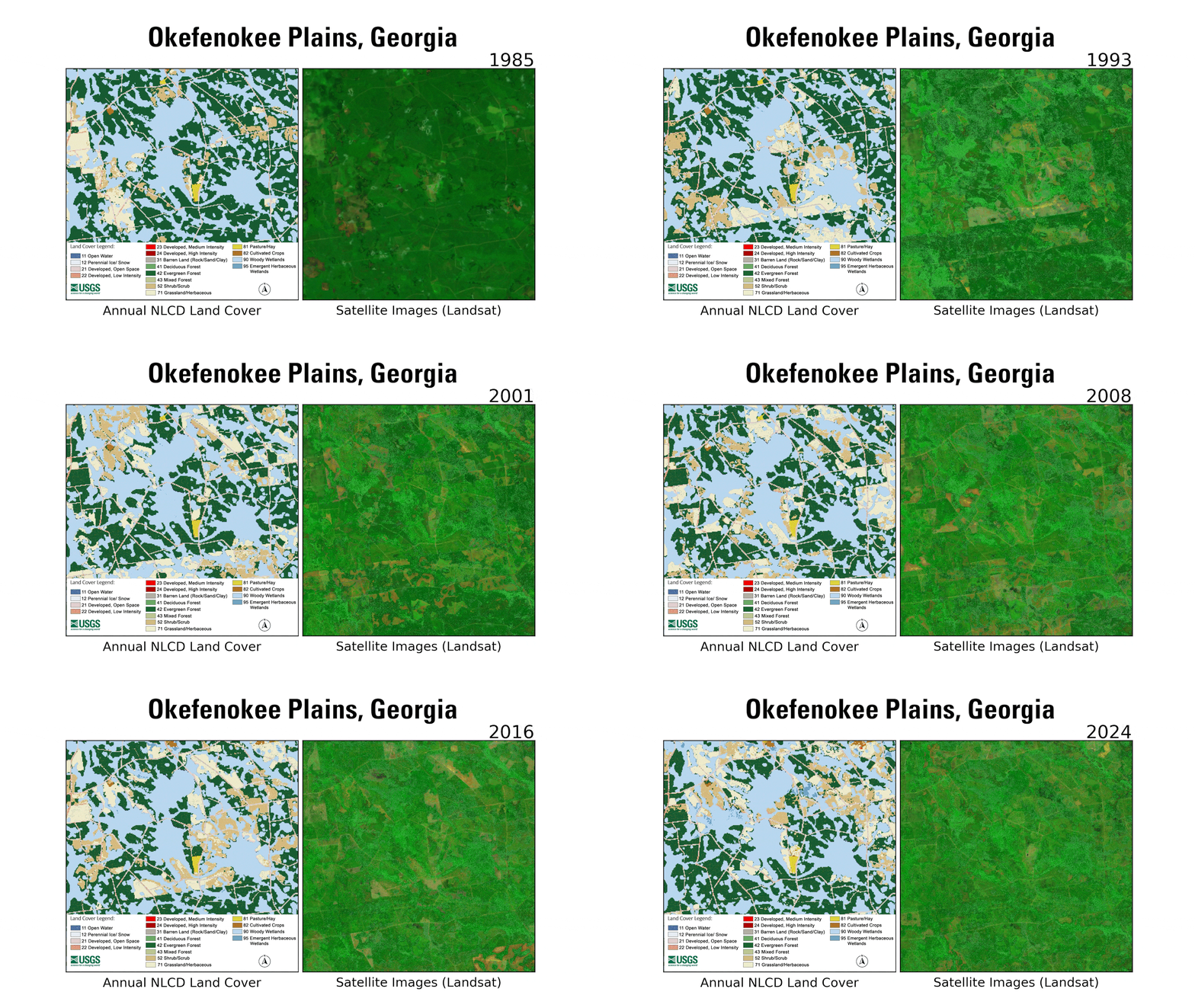
Annual NLCD and Landsat animations of a portion of the Okefenokee PlainAnnual National Land Cover Database (NLCD) and Landsat animations of a portion of the Okefenokee Plain in Georgia.
Annual NLCD and Landsat animations of a portion of the Okefenokee Plain
Annual NLCD and Landsat animations of a portion of the Okefenokee PlainAnnual National Land Cover Database (NLCD) and Landsat animations of a portion of the Okefenokee Plain in Georgia.
Landsat 9 False Color Image of the Beaufort Sea Shoreline
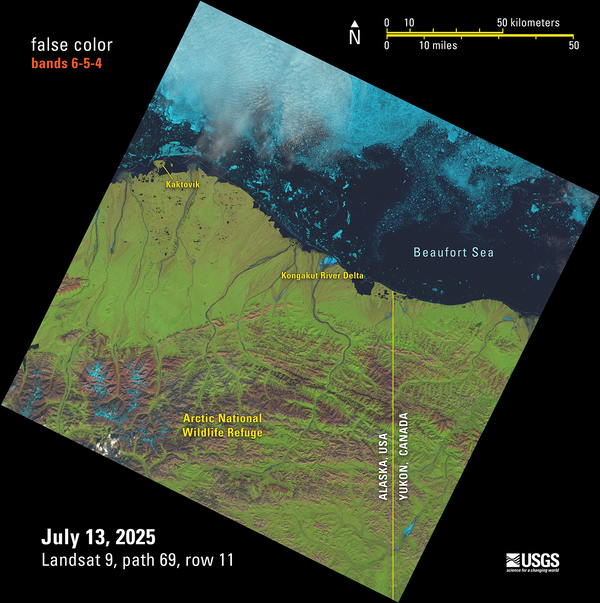
Landsat 9 False Color Image of the Beaufort Sea ShorelineThis Landsat 9 image showing the Beaufort Sea shoreline off of Alaska and Canada is just one of the scenes captured and processed on July 13, 2025— that day, the USGS EROS archive reached a milestone of one million Landsat 9 Level-1 products. This false color image was made with bands 6,5, and 4 from the Operational Land Imager.
Landsat 9 False Color Image of the Beaufort Sea Shoreline
Landsat 9 False Color Image of the Beaufort Sea ShorelineThis Landsat 9 image showing the Beaufort Sea shoreline off of Alaska and Canada is just one of the scenes captured and processed on July 13, 2025— that day, the USGS EROS archive reached a milestone of one million Landsat 9 Level-1 products. This false color image was made with bands 6,5, and 4 from the Operational Land Imager.
Landsat 8-9 Descending Acquisition Priority Map
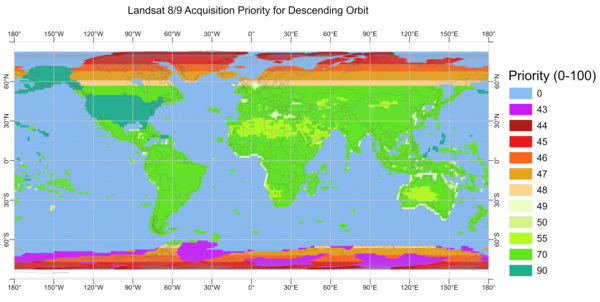
This map displays the geographic coverage of descending (daytime) image acquisition priorities for Landsat 8 and Landsat 9 on a typical day. The priority scale denotes 0 (low priority) to 100 (high priority).
This map displays the geographic coverage of descending (daytime) image acquisition priorities for Landsat 8 and Landsat 9 on a typical day. The priority scale denotes 0 (low priority) to 100 (high priority).
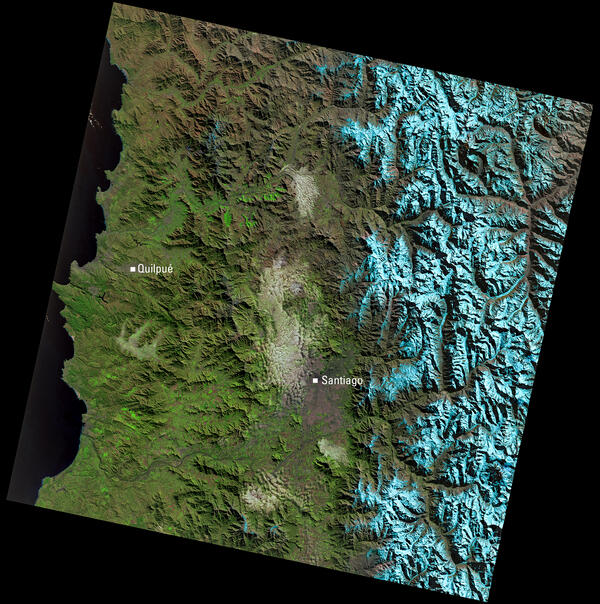
Landsat View of Central Chile and the Andes Mountains
Landsat View of Central Chile and the Andes MountainsThis Landsat 9 image of central Chile, acquired July 10, 2025, uses the shortwave infrared, near infrared, and red spectral bands ( bands 6,5,4) to highlight land cover. In this combination, healthy vegetation appears bright green, while snow and ice in the Andes Mountains show in bright blue.
Landsat View of Central Chile and the Andes Mountains
Landsat View of Central Chile and the Andes MountainsThis Landsat 9 image of central Chile, acquired July 10, 2025, uses the shortwave infrared, near infrared, and red spectral bands ( bands 6,5,4) to highlight land cover. In this combination, healthy vegetation appears bright green, while snow and ice in the Andes Mountains show in bright blue.

Landsat 7 Mission - by the Numbers
The Landsat 7 satellite was launched on April 15, 1999. The mission was decommissioned on June 4, 2025. The data collected by the satellite's sensor from 1999 to 2024 is a key part of Landsat’s 50-plus year record of imaging our planet’s surface and are preserved in the USGS Earth Resources Observation and Science (EROS) Center archive.
The Landsat 7 satellite was launched on April 15, 1999. The mission was decommissioned on June 4, 2025. The data collected by the satellite's sensor from 1999 to 2024 is a key part of Landsat’s 50-plus year record of imaging our planet’s surface and are preserved in the USGS Earth Resources Observation and Science (EROS) Center archive.

Water ribbons and shoals near the Marquesas Keys
The Marquesas Keys are situated at the western edge of the Key West National Wildlife Refuge in Florida and are part of the Florida Keys Wilderness. The islands are at a low elevation (about 6-10 feet above sea level), and have beaches tangled with mangroves that allow protection for wildlife resources.
The Marquesas Keys are situated at the western edge of the Key West National Wildlife Refuge in Florida and are part of the Florida Keys Wilderness. The islands are at a low elevation (about 6-10 feet above sea level), and have beaches tangled with mangroves that allow protection for wildlife resources.