



These Landsat 9 Level-1, Level-2 Surface Reflectance, and Level-2 Surface Temperature images show the Columbia River in the northwestern United States.
Images
Explore the images on this page to learn more about the Landsat sensors, satellites and missions.
Filter Total Items: 415
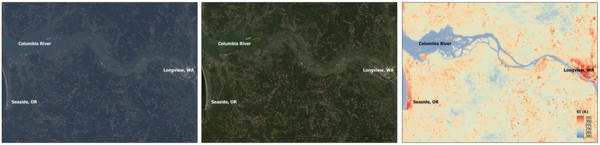
Landsat Collection 2 Level-1 and Level-2 Images
These Landsat 9 Level-1, Level-2 Surface Reflectance, and Level-2 Surface Temperature images show the Columbia River in the northwestern United States.
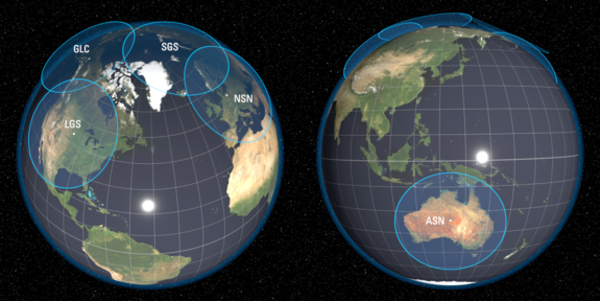
Landsat 8 and Landsat 9 Ground Network
United States ground stations in South Dakota and Alaska, as well as international ground stations in Norway, Germany, and Australia, serve as the primary data capture and Telemetry, Tracking, and Control (TT&C) facilities for the USGS Landsat satellite missions.
United States ground stations in South Dakota and Alaska, as well as international ground stations in Norway, Germany, and Australia, serve as the primary data capture and Telemetry, Tracking, and Control (TT&C) facilities for the USGS Landsat satellite missions.
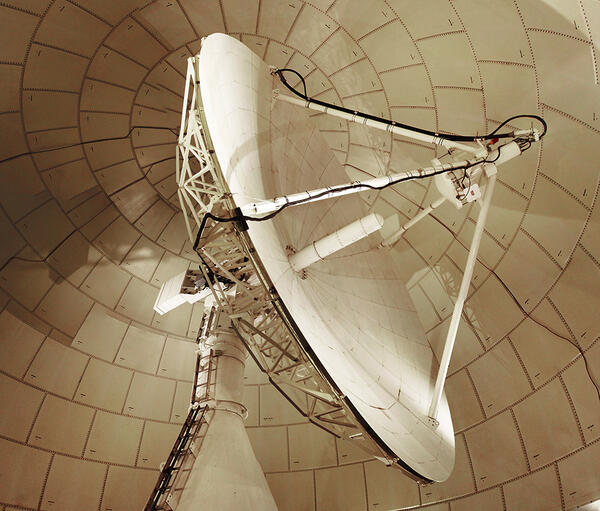
Landsat Satellite Dish Inside the USGS EROS Radome
Landsat Satellite Dish Inside the USGS EROS RadomeThe Landsat satellite dish is housed in a protective radome on the USGS EROS grounds. The dish receives data from the Landsat 8 and Landsat 9 satellites each day.
Landsat Satellite Dish Inside the USGS EROS Radome
Landsat Satellite Dish Inside the USGS EROS RadomeThe Landsat satellite dish is housed in a protective radome on the USGS EROS grounds. The dish receives data from the Landsat 8 and Landsat 9 satellites each day.
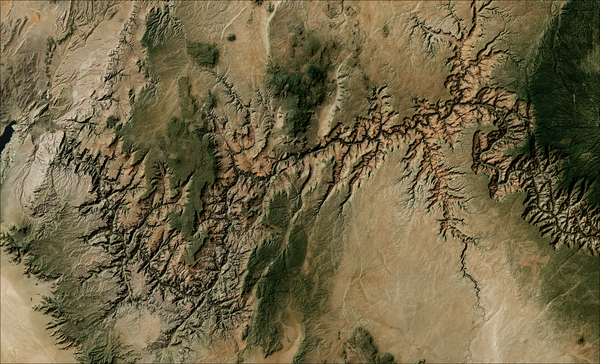
Landsat View of the Grand Canyon
Landsat 8 and 9 imagery combined with National Elevation Dataset topography reveals a detailed mosaic of the Grand Canyon, highlighting its dramatic cliffs, deep tributaries, and rugged plateau terrain.
Landsat 8 and 9 imagery combined with National Elevation Dataset topography reveals a detailed mosaic of the Grand Canyon, highlighting its dramatic cliffs, deep tributaries, and rugged plateau terrain.
Landsat View of Blythe, California
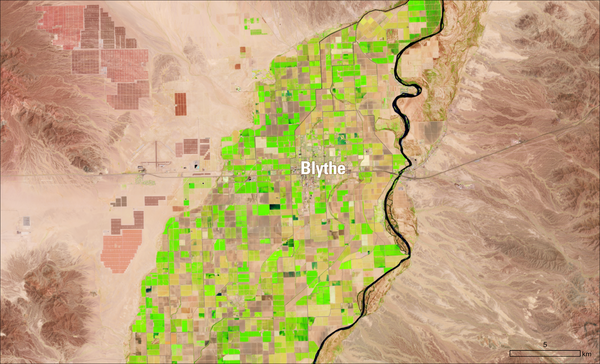
This Landsat image from July 23, 2026, shows agricultural fields surrounding Blythe, California, along the Colorado River. The shortwave infrared, near-infrared, and red band combination (Bands 6,5,4) highlights actively growing vegetation in bright green.
This Landsat image from July 23, 2026, shows agricultural fields surrounding Blythe, California, along the Colorado River. The shortwave infrared, near-infrared, and red band combination (Bands 6,5,4) highlights actively growing vegetation in bright green.
Evapotranspiration Near Blythe, California
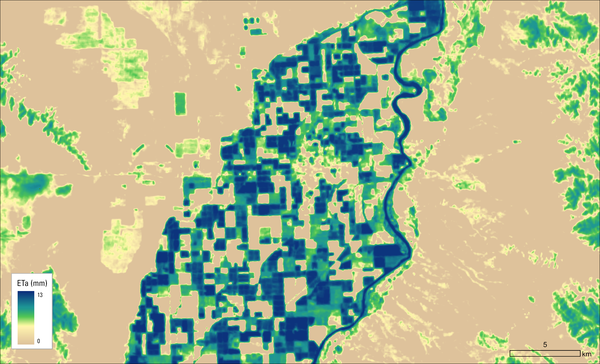
This map shows the Landsat Actual Evapotranspiration (ETa) for the Blythe area on July 23, 2026. Darker blues represent higher amounts of water transferred from the land to the atmosphere through evaporation and plant transpiration, primarily in irrigated fields and along the Colorado River.
This map shows the Landsat Actual Evapotranspiration (ETa) for the Blythe area on July 23, 2026. Darker blues represent higher amounts of water transferred from the land to the atmosphere through evaporation and plant transpiration, primarily in irrigated fields and along the Colorado River.
Landsat Product Downloads by Volume
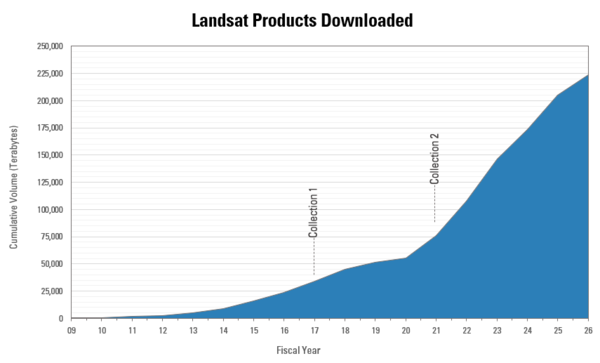
This graphic displays the cumulative volume of all operational Landsat products downloaded from the USGS EROS Landsat archive since December 2008 (FY2009). The release of Landsat Collection 2 products in 2020, which improved data quality and accessibility, helped drive downloads upward.
This graphic displays the cumulative volume of all operational Landsat products downloaded from the USGS EROS Landsat archive since December 2008 (FY2009). The release of Landsat Collection 2 products in 2020, which improved data quality and accessibility, helped drive downloads upward.
Available Landsat Level-2 Science Products
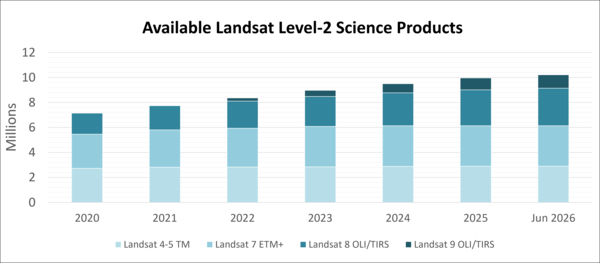
This graphic displays the number of Landsat Collection 2 Level-2 scene-based science products that are available for download from the USGS Archive. Level-2 science products were first introduced with the Collection 2 release in December, 2020. The Level-2 Science Product includes surface reflection and surface temperature data.
This graphic displays the number of Landsat Collection 2 Level-2 scene-based science products that are available for download from the USGS Archive. Level-2 science products were first introduced with the Collection 2 release in December, 2020. The Level-2 Science Product includes surface reflection and surface temperature data.
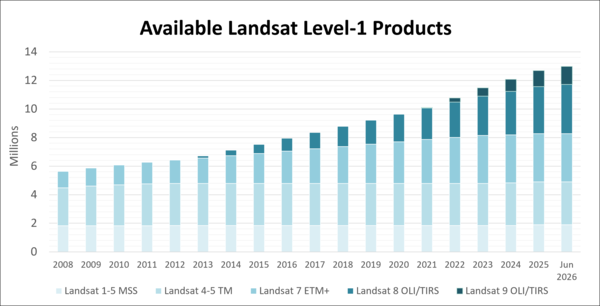
Available Landsat Level-1 Products
This graph shows the number of Landsat Collection 2 Level-1 scene-based products that are available for download from the USGS Archive. Please note that data from earlier Landsat missions, even those that have ended, continues to be added to the archive through the Landsat Global Archive Consolidation (LGAC) program.
This graph shows the number of Landsat Collection 2 Level-1 scene-based products that are available for download from the USGS Archive. Please note that data from earlier Landsat missions, even those that have ended, continues to be added to the archive through the Landsat Global Archive Consolidation (LGAC) program.
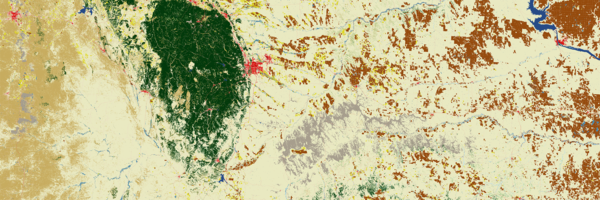
2025 Annual NLCD land cover image of western South Dakota
2025 Annual NLCD land cover image of western South DakotaThis 2025 Annual National Land Cover Database (NLCD) land cover image shows a portion of western South Dakota. The Black Hills stand out in green, and the urban area of Rapid City in red at its eastern edge. The Badlands show up as gray hues, and vast range and grasslands fill the area leading over to the Missouri River.
2025 Annual NLCD land cover image of western South Dakota
2025 Annual NLCD land cover image of western South DakotaThis 2025 Annual National Land Cover Database (NLCD) land cover image shows a portion of western South Dakota. The Black Hills stand out in green, and the urban area of Rapid City in red at its eastern edge. The Badlands show up as gray hues, and vast range and grasslands fill the area leading over to the Missouri River.
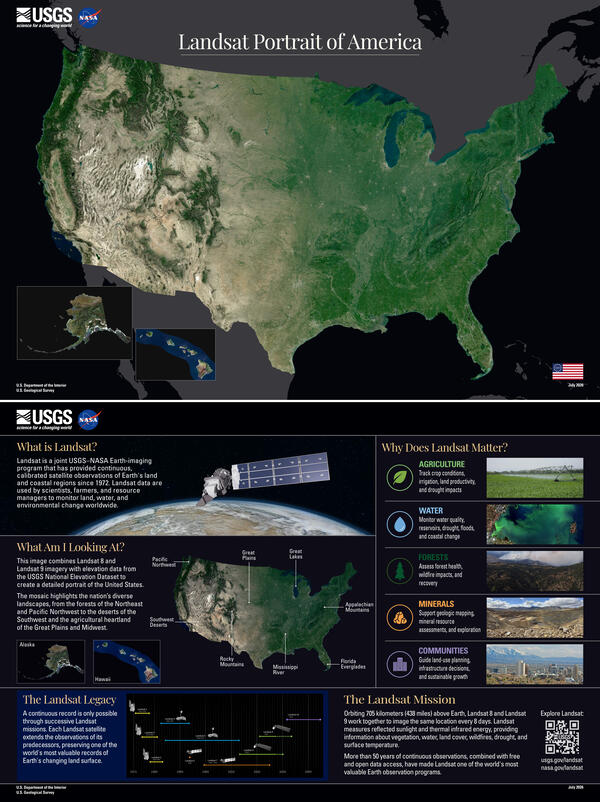
Landsat Portrait of America
The complete Landsat Portrait of America poster, shown with the front on top and the back below.
The complete Landsat Portrait of America poster, shown with the front on top and the back below.
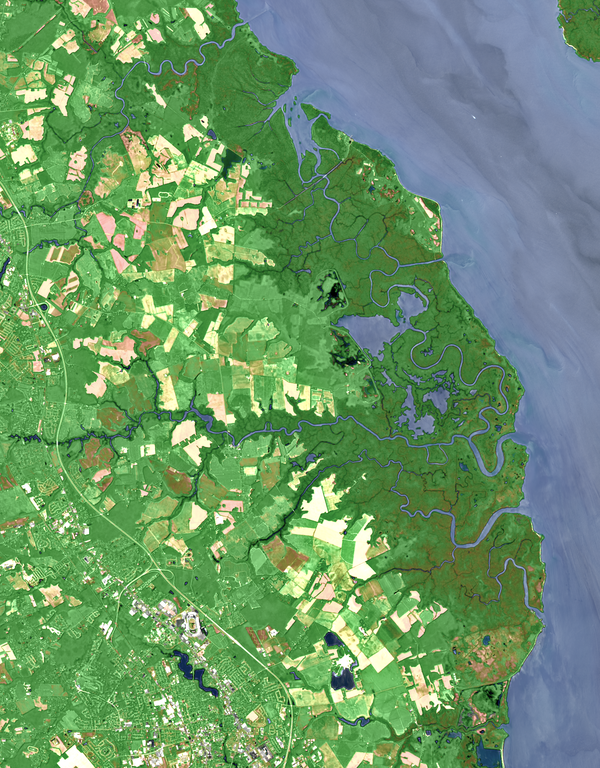
Bombay Hook National Wildlife Refuge
Delaware’s low-lying coast makes it especially vulnerable to flooding, erosion, and rising seas. Wetlands like those at Bombay Hook National Wildlife Refuge help protect nearby communities while providing critical habitat for migratory birds.
Delaware’s low-lying coast makes it especially vulnerable to flooding, erosion, and rising seas. Wetlands like those at Bombay Hook National Wildlife Refuge help protect nearby communities while providing critical habitat for migratory birds.
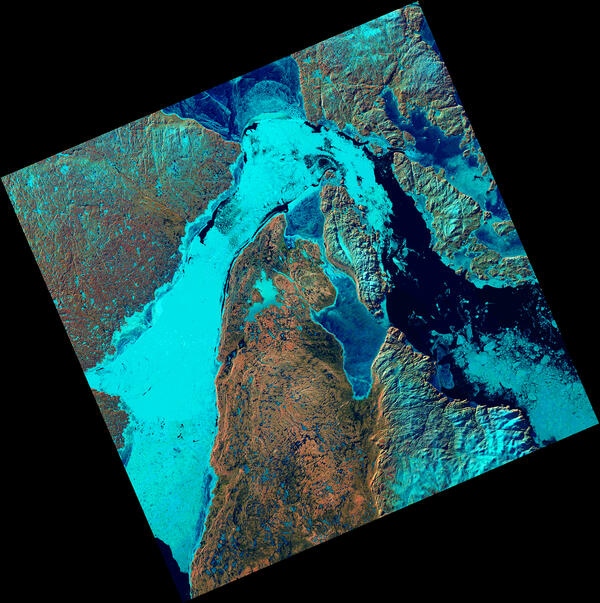
Ice Fills Roes Welcome Sound
The Landsat 8 satellite captured an image showing sea ice packed into Roes Welcome Sound, located along the northwestern edge of Southampton Island and around Qikiqtaaluk Island in the uninhabited Canadian Arctic Archipelago. East of Qikiqtaaluk, ice drifts through the Frozen Strait, extending eastward into Foxe Basin.
The Landsat 8 satellite captured an image showing sea ice packed into Roes Welcome Sound, located along the northwestern edge of Southampton Island and around Qikiqtaaluk Island in the uninhabited Canadian Arctic Archipelago. East of Qikiqtaaluk, ice drifts through the Frozen Strait, extending eastward into Foxe Basin.

Dr. Eric Vermote
Dr. Eric Vermote is a research scientist with NASA. Dr. Vermote is a member of the Landsat Science Team.
Photo credit: NASA
Dr. Eric Vermote is a research scientist with NASA. Dr. Vermote is a member of the Landsat Science Team.
Photo credit: NASA

Dr. Jim Irons
Dr. Jim Irons, Landsat Data Continuity Mission (LDCM) project scientist from NASA's Goddard Space Flight Center, speaks to NASA social media followers at Vandenberg Air Force Base, Calif., prior to the launch of the LDCM satellite, which was later renamed Landsat 8 after reaching orbit.
Photo credit: NASA
Dr. Jim Irons, Landsat Data Continuity Mission (LDCM) project scientist from NASA's Goddard Space Flight Center, speaks to NASA social media followers at Vandenberg Air Force Base, Calif., prior to the launch of the LDCM satellite, which was later renamed Landsat 8 after reaching orbit.
Photo credit: NASA
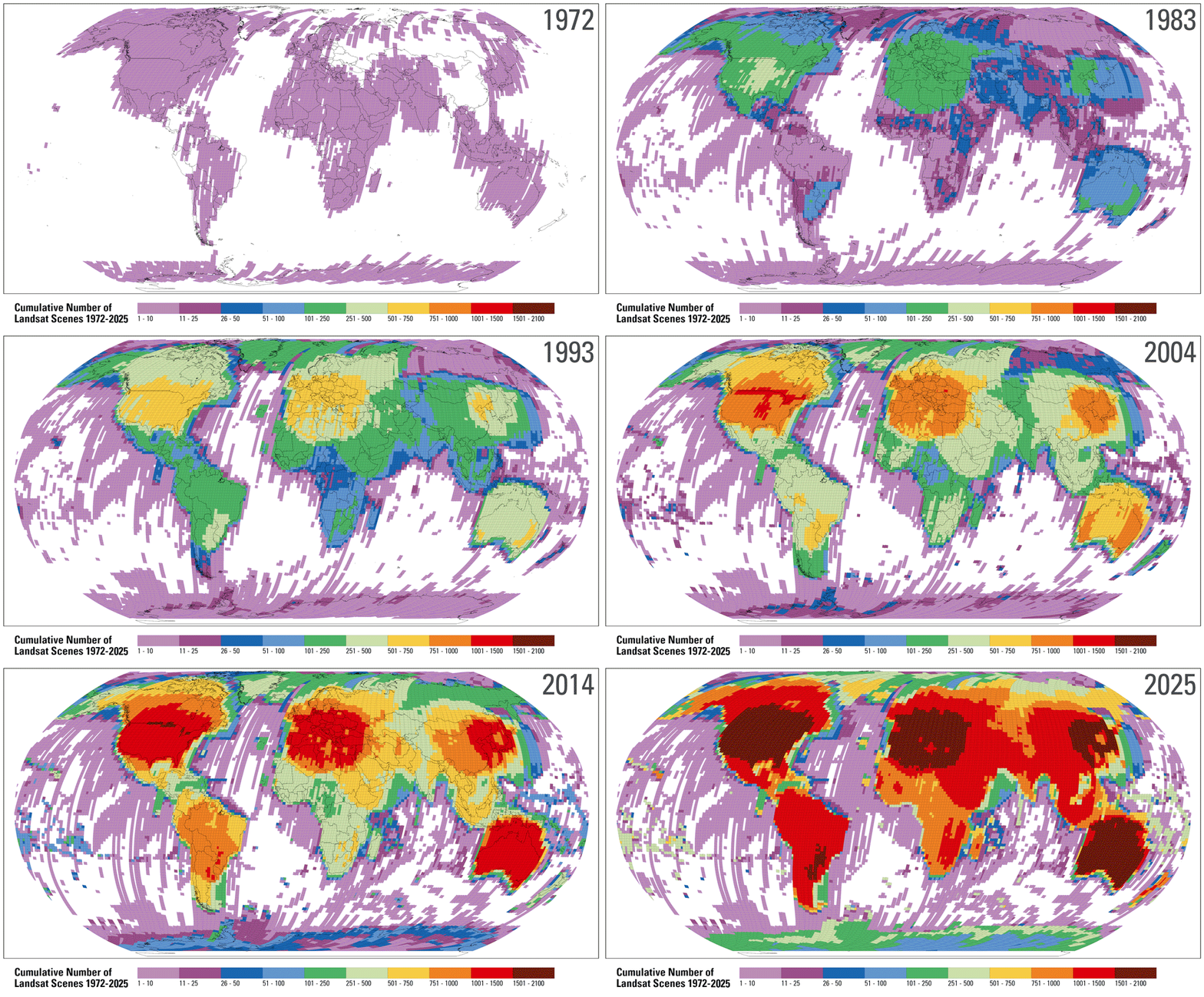
Cumulative Number of Landsat Scenes
The USGS Landsat archive holds over fifty years of Earth-Observing satellite data. This animation displays the cumulative number of Landsat scenes since 1972. The colors on the maps show the density of the number of Landsat Level-1 products.
The USGS Landsat archive holds over fifty years of Earth-Observing satellite data. This animation displays the cumulative number of Landsat scenes since 1972. The colors on the maps show the density of the number of Landsat Level-1 products.
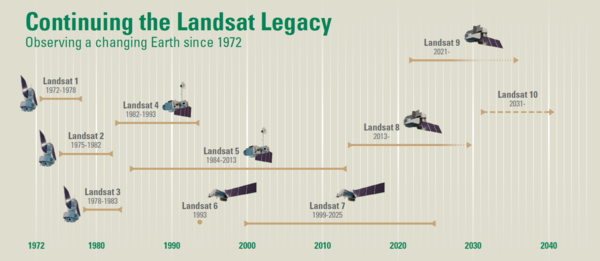
Continuing the Landsat Legacy
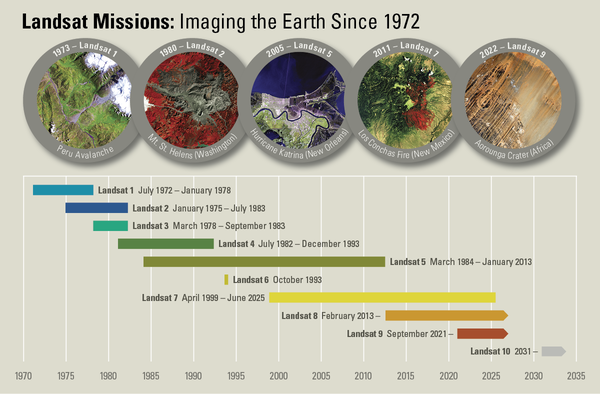
Timeline of the Landsat program, beginning with the launch of Landsat 1 in 1972. Landsat 10 is expected to launch in 2031. As the tenth Landsat mission, it will continue the legacy of the Landsat program.
Visit the Landsat Missions webpage to learn more.
Timeline of the Landsat program, beginning with the launch of Landsat 1 in 1972. Landsat 10 is expected to launch in 2031. As the tenth Landsat mission, it will continue the legacy of the Landsat program.
Visit the Landsat Missions webpage to learn more.
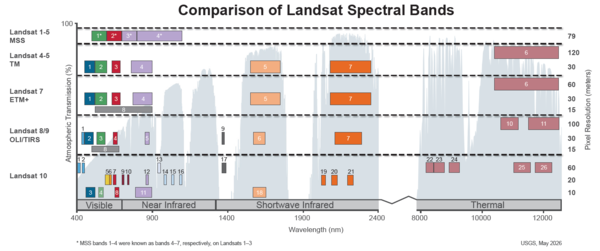
Spectral Bandpasses for all Landsat Sensors
This image shows the spectral bandpasses for the sensors on all Landsat satellites.
This image shows the spectral bandpasses for the sensors on all Landsat satellites.
Worldwide Reference System-3 (WRS-3)
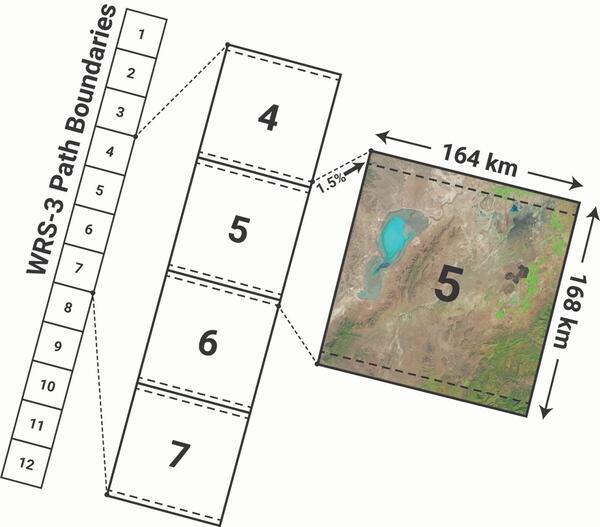
A new Worldwide Reference System, WRS-3, was developed for Landsat 10 due to the change in orbital parameters. The WRS-3 will provide a method to acquire, index, and catalog Landsat 10 scenes.
A new Worldwide Reference System, WRS-3, was developed for Landsat 10 due to the change in orbital parameters. The WRS-3 will provide a method to acquire, index, and catalog Landsat 10 scenes.
Spectral Comparison of Landsat 8-9 and Landsat 10
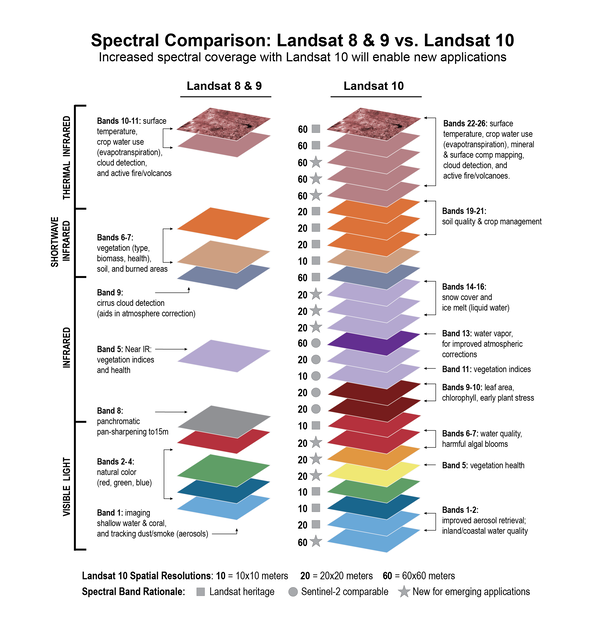
This illustration compares the spectral bands of the sensors onboard Landsat 8 and Landsat 9, compared to the 26 bands that will capture imagery on Landsat 10. Refined and new bands will allow easier merging of data products and support emerging Landsat applications.
This illustration compares the spectral bands of the sensors onboard Landsat 8 and Landsat 9, compared to the 26 bands that will capture imagery on Landsat 10. Refined and new bands will allow easier merging of data products and support emerging Landsat applications.
Landsat Missions Timeline
In a September 21, 1966 press release, Secretary of the Interior Stewart Udall announced that the DOI was launching "Project EROS (Earth Resources Observation Satellites)." Udall's vision was to observe the Earth for the benefit of all.
In a September 21, 1966 press release, Secretary of the Interior Stewart Udall announced that the DOI was launching "Project EROS (Earth Resources Observation Satellites)." Udall's vision was to observe the Earth for the benefit of all.