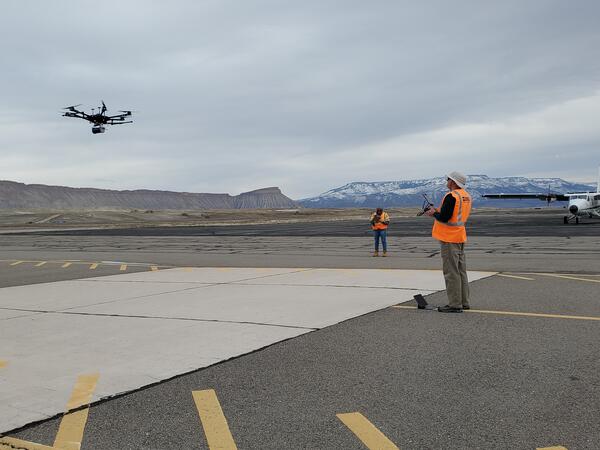
USGS remote pilot powers on UAS in White Sands National Park, April 2023
USGS remote pilot powers on UAS in White Sands National Park, April 2023USGS remote pilot Todd Burton powers on UAS in White Sands National Park, April 2023
An official website of the United States government
Here's how you know
Official websites use .gov
A .gov website belongs to an official government organization in the United States.
Secure .gov websites use HTTPS
A lock () or https:// means you’ve safely connected to the .gov website. Share sensitive information only on official, secure websites.
The U.S. Geological Survey (USGS) National Uncrewed Systems Office (NUSO) leads the research activities needed to make Uncrewed Aircraft Systems (UAS) data collection an efficient, safe, and cost-effective remote sensing tool for Department of the Interior (DOI) and USGS scientists.
We focus on the evaluation of new platforms, integration of new UAS-compatible sensors, development of data specifications and processing techniques, recommendations of UAS data acquisition best-practices, and operational support for new and existing DOI remote pilots.
We are a team of platform and UAS-compatible sensor subject matter experts that, in addition to research, provide operational support to DOI remote pilots and outreach to federal, public, and international audiences. Our office, established on May 8th, 2008, operates as part of the National Land Imaging Program, and contributes to its goal to provide the Federal Government and the public with the remotely sensed data and applications needed to support our Nation’s economic security and environmental vitality.
Products listed below were supported through the use of UAS technologies and resources at USGS.
USGS remote pilot Todd Burton powers on UAS in White Sands National Park, April 2023
Drone-captured group photo with USGS remote pilots, White Sands National Park personnel, and USGS geologists standing in and next to a study area with fossilized tracks.
Drone selfie captured using a Skydio X2D UAS of the team standing in front of the DOE-LM Calibration Pads at the Grand Junction Regional Airport in Colorado. From left to right: Joel Doebele (DOE-LM contractor), Anji Shah (USGS), Chelsea Amaral (USGS), Brandon Mittan (GJT), Matt Burgess (USGS), and Joe Adams (USGS).
Drone's eye view of a USGS remote pilot during a biocrust mission near Moab, UT
USGS researchers teamed up for a biological soil crust (biocrust) remote sensing and field data campaign near Moab, Utah in February of 2022.
USGS scientists Joe Adams and Matt Burgess conduct a UAS lidar data collection flight at the Vicksburg National Military Park
NUSO scientists, along with USGS landslide researchers, in December 2022 undertook a topographic analysis of slide-prone areas of the National Park Service Vicksburg National Military Park near Vicksburg, Mississippi.
USGS scientists Joe Adams and Matt Burgess conduct a UAS lidar data collection flight at the Vicksburg National Military Park
NUSO scientists, along with USGS landslide researchers, in December 2022 undertook a topographic analysis of slide-prone areas of the National Park Service Vicksburg National Military Park near Vicksburg, Mississippi.
USGS employee Joe Adams positions a UAS over a calibration panel to capture a multispectral image with the attached MicaSense Dual multispectral sensor. This calibration image will be used to post-process the imagery in support of radiometric calibration research conducted at the Denver Federal Center in Colorado.
USGS NUSO scientists act as a visual observer (Joe Adams left) and a UAS remote pilot (Matt Burgess right) during a UAS flight at the Denver Federal Center
USGS employees from the USGS National Uncrewed Systems Office (NUSO) and the USGS EROS CalVal Center of Excellence (ECCOE) during a UAS test in a Denver Federal Center parking lot.
UAS carrying the methane sensor (left) and a smaller UAS used to collect videos and photos (right) in Alaska
Permafrost is ground that has been frozen for at least two years. With the warming climate, permafrost across Alaska is thawing and greenhouse gases such as methane are released as a result. Ecologist Kristen Manies of the U.S.
USGS researcher Victoria Scholl (NUSO) checks the image quality of photos captured using the Mavic Pro UAS over a bog in Alaska. These photos will be used to generate a Structure from Motion photogrammetry orthomosaic.
UAS carrying the methane sensor (left) and a smaller UAS used to collect videos and photos (right) in Alaska. Both UAS are resting on wooden pallets that the team set onto the bog for a dry and flat takeoff/landing location.
Victoria Scholl (NUSO), Kristen Manies (GMEG Science Center), and Joe Adams (NUSO) hiked the UAS gear through the woods and across a network of boardwalks to access the bog site at the BNZ LTER.
Image from a UAS acquired natural color video showing the UAS-mounted Kolibri sensor being flown through the smoke plume during one of the in-situ oil burns at a Poker Flat Research Range retention pond in Alaska.
USGS researcher Joe Adams tacking down a calibration tarp at the Eastern Ecological Science Center - Leetown Research Laboratory.
USGS researcher Matt Burgess remotely pilots a UAS collecting lidar data during the April 2022 USGS UASnow project at Berthoud Pass, Colorado.
A UAS collecting natural color video over one of the study sites during a joint NUSO and USGS Water Resources Mission Area snow mapping project in Winter Park, Colorado.
USGS researcher Joe Adams (NUSO) setting up a GPS base station at one of the study sites for a snow mapping project in Winter Park, Colorado. GPS base station data is used in post-processing to improve the geospatial accuracy of UAS collected data.
USGS NUSO researchers Victoria Scholl and Mark Bauer take a moment to enjoy the scenery during a UAS data collection for the snow water equivalent (SWE) project at the Berthoud Pass Colorado study site.
Please don’t walk on the biocrust!
Drone's eye view of a USGS remote pilot during a biocrust mission near Moab, UT
NUSO UAS pilot Matt Burgess captures an image of himself while landing a UAS after a flight over a biocrust site near Moab, Utah.
Drone's eye view of a USGS remote pilot during a biocrust mission near Moab, UT
NUSO UAS pilot Matt Burgess captures an image of himself while landing a UAS after a flight over a biocrust site near Moab, Utah.
USGS researcher Victoria Scholl (NUSO) returns after collecting previously deployed scale bar and ground control point survey targets along the Paleocene Poison Canyon Formation in the Cimarron Canyon, New Mexico.
Products listed below were supported through the use of UAS technologies and resources at USGS.
These are archived accounts and not currently being updated. For the latest updates follow @USGS.
The U.S. Geological Survey (USGS) National Uncrewed Systems Office (NUSO) leads the research activities needed to make Uncrewed Aircraft Systems (UAS) data collection an efficient, safe, and cost-effective remote sensing tool for Department of the Interior (DOI) and USGS scientists.
We focus on the evaluation of new platforms, integration of new UAS-compatible sensors, development of data specifications and processing techniques, recommendations of UAS data acquisition best-practices, and operational support for new and existing DOI remote pilots.
We are a team of platform and UAS-compatible sensor subject matter experts that, in addition to research, provide operational support to DOI remote pilots and outreach to federal, public, and international audiences. Our office, established on May 8th, 2008, operates as part of the National Land Imaging Program, and contributes to its goal to provide the Federal Government and the public with the remotely sensed data and applications needed to support our Nation’s economic security and environmental vitality.
Products listed below were supported through the use of UAS technologies and resources at USGS.
USGS remote pilot Todd Burton powers on UAS in White Sands National Park, April 2023
Drone-captured group photo with USGS remote pilots, White Sands National Park personnel, and USGS geologists standing in and next to a study area with fossilized tracks.
Drone selfie captured using a Skydio X2D UAS of the team standing in front of the DOE-LM Calibration Pads at the Grand Junction Regional Airport in Colorado. From left to right: Joel Doebele (DOE-LM contractor), Anji Shah (USGS), Chelsea Amaral (USGS), Brandon Mittan (GJT), Matt Burgess (USGS), and Joe Adams (USGS).
Drone's eye view of a USGS remote pilot during a biocrust mission near Moab, UT
USGS researchers teamed up for a biological soil crust (biocrust) remote sensing and field data campaign near Moab, Utah in February of 2022.
USGS scientists Joe Adams and Matt Burgess conduct a UAS lidar data collection flight at the Vicksburg National Military Park
NUSO scientists, along with USGS landslide researchers, in December 2022 undertook a topographic analysis of slide-prone areas of the National Park Service Vicksburg National Military Park near Vicksburg, Mississippi.
USGS scientists Joe Adams and Matt Burgess conduct a UAS lidar data collection flight at the Vicksburg National Military Park
NUSO scientists, along with USGS landslide researchers, in December 2022 undertook a topographic analysis of slide-prone areas of the National Park Service Vicksburg National Military Park near Vicksburg, Mississippi.
USGS employee Joe Adams positions a UAS over a calibration panel to capture a multispectral image with the attached MicaSense Dual multispectral sensor. This calibration image will be used to post-process the imagery in support of radiometric calibration research conducted at the Denver Federal Center in Colorado.
USGS NUSO scientists act as a visual observer (Joe Adams left) and a UAS remote pilot (Matt Burgess right) during a UAS flight at the Denver Federal Center
USGS employees from the USGS National Uncrewed Systems Office (NUSO) and the USGS EROS CalVal Center of Excellence (ECCOE) during a UAS test in a Denver Federal Center parking lot.
UAS carrying the methane sensor (left) and a smaller UAS used to collect videos and photos (right) in Alaska
Permafrost is ground that has been frozen for at least two years. With the warming climate, permafrost across Alaska is thawing and greenhouse gases such as methane are released as a result. Ecologist Kristen Manies of the U.S.
USGS researcher Victoria Scholl (NUSO) checks the image quality of photos captured using the Mavic Pro UAS over a bog in Alaska. These photos will be used to generate a Structure from Motion photogrammetry orthomosaic.
UAS carrying the methane sensor (left) and a smaller UAS used to collect videos and photos (right) in Alaska. Both UAS are resting on wooden pallets that the team set onto the bog for a dry and flat takeoff/landing location.
Victoria Scholl (NUSO), Kristen Manies (GMEG Science Center), and Joe Adams (NUSO) hiked the UAS gear through the woods and across a network of boardwalks to access the bog site at the BNZ LTER.
Image from a UAS acquired natural color video showing the UAS-mounted Kolibri sensor being flown through the smoke plume during one of the in-situ oil burns at a Poker Flat Research Range retention pond in Alaska.
USGS researcher Joe Adams tacking down a calibration tarp at the Eastern Ecological Science Center - Leetown Research Laboratory.
USGS researcher Matt Burgess remotely pilots a UAS collecting lidar data during the April 2022 USGS UASnow project at Berthoud Pass, Colorado.
A UAS collecting natural color video over one of the study sites during a joint NUSO and USGS Water Resources Mission Area snow mapping project in Winter Park, Colorado.
USGS researcher Joe Adams (NUSO) setting up a GPS base station at one of the study sites for a snow mapping project in Winter Park, Colorado. GPS base station data is used in post-processing to improve the geospatial accuracy of UAS collected data.
USGS NUSO researchers Victoria Scholl and Mark Bauer take a moment to enjoy the scenery during a UAS data collection for the snow water equivalent (SWE) project at the Berthoud Pass Colorado study site.
Please don’t walk on the biocrust!
Drone's eye view of a USGS remote pilot during a biocrust mission near Moab, UT
NUSO UAS pilot Matt Burgess captures an image of himself while landing a UAS after a flight over a biocrust site near Moab, Utah.
Drone's eye view of a USGS remote pilot during a biocrust mission near Moab, UT
NUSO UAS pilot Matt Burgess captures an image of himself while landing a UAS after a flight over a biocrust site near Moab, Utah.
USGS researcher Victoria Scholl (NUSO) returns after collecting previously deployed scale bar and ground control point survey targets along the Paleocene Poison Canyon Formation in the Cimarron Canyon, New Mexico.
Products listed below were supported through the use of UAS technologies and resources at USGS.
These are archived accounts and not currently being updated. For the latest updates follow @USGS.