



A resting sea otter in the Homer harbor, Alaska. Photo was taken in 2011. Sea otters provide one of the best documented examples of top-down forcing effects on the structure and function of nearshore marine ecosystems in the North Pacific Ocean.
Animals
Every Bird Counts - Delivering Gold Standard Science for North America's Birds
Observers, volunteers, and scientists provide the essential data that drives bird conservation.
Observers, volunteers, and scientists provide the essential data that drives bird conservation.
Restoring Pinto Abalone in Washington's Waters
After decades of population decline, Washington State’s pinto abalone recovery program is making meaningful progress.
After decades of population decline, Washington State’s pinto abalone recovery program is making meaningful progress.
Science in Service: How USGS Monitoring Helps the US Navy Sustain a Rare Species
A collaboration that provides rigorous scientific data on a reptile endemic to the California Channel Islands.
A collaboration that provides rigorous scientific data on a reptile endemic to the California Channel Islands.
USGS Pollinator Science Strategy, 2025-2035
Supporting management, conservation, and decisions on pollinators and their habitats.
Supporting management, conservation, and decisions on pollinators and their habitats.
Carolina Wrens and the Carters - A Brief History of the North American Breeding Bird Survey
Jimmy and Rosalynn Carter joined a landmark effort to monitor bird populations.
Jimmy and Rosalynn Carter joined a landmark effort to monitor bird populations.
What 100 Years of USGS Bird Monitoring Data Tell Us About Hummingbirds
Banding and survey data uncover how hummingbird populations are changing over time.
Banding and survey data uncover how hummingbird populations are changing over time.
Supporting the Outdoor Recreation Economy
Shifting wildlife patterns are reshaping where, when, and how Americans enjoy the outdoors.
Shifting wildlife patterns are reshaping where, when, and how Americans enjoy the outdoors.
Healthy animal and plant communities form the foundation of healthy ecosystems, and in turn, healthy ecosystems benefit humans in countless ways. From the furry to the scaly, USGS science contributes to the restoration, protection, and conservation of fish and wildlife for generations to come.
Animals We Study
As the principal science arm of the U.S. Department of the Interior (DOI), the USGS provides science to help the Nation achieve sustainable management and conservation of plants and animals. Healthy ecosystems contain a diversity of thriving animal populations which makes them more resistant and resilient to threats. Loss of animal species means a loss of biodiversity and thus healthy ecosystems. Declines in animal populations have been documented worldwide due to threats from climate change, disease, and habitat loss. Our scientists monitor at-risk species, identify how animals respond to climate change and habitat loss, and find solutions to address fish wildlife diseases. This information is used by federal, state, and tribal natural resource managers to make management decisions that support our Nation’s fish and wildlife now and into the future. Read on to learn about the animals we study.
Terrestrial Mammals
Terrestrial Mammals
Marine Mammals
Marine Mammals
Reptiles
Reptiles
Amphibians
Amphibians
Fish
Fish
Birds
Birds
Pollinators
Pollinators
Invertebrates
Invertebrates
Threats to Animals
Media

Sources/Usage: Public Domain. View Media Details
Climate change, urbanization, habitat loss, the spread of invasive species – these and other threats pose a significant challenge to wildlife managers. Biological threats to animals like diseases and invasive species can spread through nature and cause an incredible ripple effect on humans. These threats are costly and endanger not only wildlife, but also livestock, agriculture, forestry, public health, water quality, and recreational resources that people rely on.
Understanding, monitoring, and predicting threats to animals contributes to the USGS goal of providing science to support the protection, conservation, and enhancement of the Nation’s biodiversity. USGS scientists study how animal populations are responding to threats and help arm managers and the public with the information and tools they need to choose the most effective management strategies that will support species now and into the future.
Invasive Species
Every plant and animal species has a native habitat where it originated and is part of the natural community. When a species is introduced to a new habitat, it becomes a “non-native” species in that area. And if that non-native species is able to establish and grow in that new habitat, causing harm to the environment, economy, or humans, it becomes “invasive”. The estimated economic and health-related costs of invasive species in the U.S. have been reported at more than \$21 billion annually and adversely affect every state in the country.
The challenges that invasive species pose are innumerable. For example, invasive plants diminish the quality of fish and wildlife habitat, while invasive animals can spread diseases and compete with native animals for resources. USGS scientists study hundreds of invasive species, including invasive carp in the Mississippi River and its tributaries, Burmese pythons in the Everglades, and zebra and quagga mussels in the Great Lakes. Learn more>>
Disease & Contaminants
The effects of diseases, pathogens, contaminants, and toxins are global and profound, often resulting in economic and agricultural impacts, declines in wildlife populations, and ecological disturbance. Through a One Health lens, the USGS works to advance wildlife health science for the benefit of animals, humans, and the environment. We research solutions to address the deadliest wildlife diseases, detect disease-causing pathogens, and monitor the presence of dangerous chemicals and toxins in the environment that can harm people and wildlife. Learn more>>
Ecosystem Change
Media

Sources/Usage: Some content may have restrictions. View Media Details
Change is a natural part of healthy ecosystems. For example, periodic, low-intensity wildfires clear dead brush and help encourage new plant growth. However, in some cases ecosystems are pushed toward irreversible transformations. Threats like climate change, land use change, and the spread of invasive species affect how ecosystems function, which in turn has consequences for the animals, plants, and human communities that rely on them. For example, in the West, climate change is contributing to a longer wildfire season. Fires clear the way for the spread of invasive plants, like cheatgrass, resulting in less good quality habitat and food available for native wildlife like the greater sage-grouse. To make matters worse, cheatgrass is highly flammable and perpetuates cycles of more frequent, intense fires.
This is just one example of how multiple threats to ecosystems – climate change, fire, and invasive species – interact and compound to alter ecosystems and ultimately harm wildlife. USGS scientists study the impacts of these and other threats to ecosystems and the wildlife that depend on them, make predictions about how ecosystems will look in the future and what this means for wildlife, and provide science to inform ecosystem restoration and wildlife conservation. Learn more>>
Species at Risk
As a result of threats such as the spread of invasive species, disease, and climate and land use change, some animal species are in decline or in danger of extinction, and may have specific protections at the federal and state levels. The USGS provides federal and state fish and wildlife managers, and other conservation organizations with scientific information to support conservation decisions for at-risk species. Through monitoring the populations of declining species, USGS science is providing critical information on the status and health of wildlife populations.
Population Monitoring
USGS scientists collect data by going out in the field to survey wildlife or collect remotely sensed data using special detectors such as cameras and satellites. Whether we’re putting GPS collars on caribou to track their migrations, evaluating satellite imagery to see where Pacific walruses are resting on the Arctic coastline, or banding birds to track their behavior, lifespans, and health, USGS scientists are collecting the data needed to make informed management decisions for our Nation’s wildlife.
On Land
-
Grizzly bears: As participants in the Interagency Grizzly Bear Study Team, USGS scientists have been monitoring grizzly bears in Yellowstone for over 40 years—contributing to what is perhaps the largest collection of scientific information on any bear species in the world. Learn more>>
-
Caribou: Arctic caribou have the longest land migrations of any animal on Earth. How will caribou populations and migration patterns be impacted by changes in climate and energy development? USGS scientists are monitoring caribou in northern Alaska to answer these questions and more. Learn more>>
-
Mule deer: Each spring and fall, mule deer and other hoofed mammals migrate throughout the western U.S. to avoid deep snow and access nutritious forage. USGS scientists use GPS collars to track where mule deer migrate, creating maps of deer migration routes that support conservation planning. Learn more>>
-
Sage-grouse: Greater sage-grouse populations have declined significantly over the last 60 years. USGS scientists are estimating population trends for this Great Basin game bird to inform conservation decisions. Learn more>>
-
Amphibians: The U.S. is losing approximately 4% of its amphibian populations each year. Climate change is one of many drivers of amphibian die-offs. USGS scientists are monitoring amphibians on public lands and determining factors that may be causing population declines. Learn more>>
-
Desert tortoise: The threatened desert tortoise has inhabited the Southwest for millions of years. USGS scientists are investigating how changes in southwestern deserts, such as larger and more frequent wildfires, are affecting the species. Learn more>>
Media

Return of the Yellowstone grizzly bear: Hear from the experts about a 40-year long effort to monitor and understand this charismatic animal.
Sources/Usage: Public Domain. View Media Details
Media

Did you know that each species of frog has its own unique vocalization? Learn how USGS scientists are using these frog calls to track populations.
Sources/Usage: Public Domain. View Media Details
Media

Arctic caribou have the longest terrestrial migrations of any animal on Earth. Learn how USGS scientists are using GPS collars to track their movements.
Sources/Usage: Public Domain. View Media Details
In Water
- Polar bears: USGS leads long-term research on polar bears to inform policy and conservation decisions for the species and its Arctic habitat. Scientists are studying two populations in Alaska to understand how rapidly warming temperatures affect polar bear movement, denning, population size, and health. Learn more>>
- Pacific walrus: The Pacific walrus has a wide geographic distribution, which makes it difficult to know just how many there are. However, advances in genetics and drone technology have allowed USGS scientists to develop more precise estimates. Keeping tabs on walrus numbers is especially important as they continue to experience a loss of sea ice habitat. Learn more>>
- Sea Turtles: Six species of sea turtles—all protected by the Endangered Species Act—call U.S. waters home. USGS scientists are studying sea turtle habitat use, movements, and more, in the Gulf of Mexico, Florida Keys, and Caribbean. Learn more>>
- Sea Otters: These hand-holding marine mammals, found along the North Pacific coast, were decimated by the 18th and 19th century fur trade. Today, populations are continuing to recover and USGS scientists are studying the factors that affect sea otter population trends. Learn more>>
- Manatees: The Florida manatee was one of the first species listed as endangered when the Endangered Species Act went into effect in 1973. For the last 40 years, USGS scientists have been committed to understanding the biology and ecology of manatees to help managers identify actions that can help this majestic species thrive. Learn more>>
- Salmon: The Yukon River hosts some of the largest migrating salmon stocks in the world, with some fish migrating over 1,800 miles to reach their spawning grounds in the Yukon and British Columbia. But the Yukon River chinook salmon have been in decline since the 1990s, and the pace of this decline has recently accelerated. USGS scientists are exploring whether heat stress is the cause. Learn more>>
- Atlantic sturgeon: Atlantic sturgeon have been around for at least 70 million years, but populations have been depleted due to overfishing, unintentional deaths caused by commercial vessels and fishing, and habitat loss. USGS scientists are using genetics to help estimate the number of sturgeon in certain spawning runs and to better understand their migratory routes. Learn more>>
- Corals: Coral reefs cover less than 0.5% of the earth's surface but are home to an estimated 25% of all marine species. USGS scientists map, monitor, and model coral reefs to better understand how we can protect these incredibly important ecosystems. Learn more>>
- Stoneflies: The threatened meltwater stonefly and glacier stonefly are restricted to short sections of cold streams fed by disappearing glaciers and permanent snowfields in Glacier National Park. USGS scientists are investigating the impacts of glacier and snow loss on the distribution, abundance, and genetic diversity of these cryptic critters. Learn more>>
Media

How have coral reefs changed over the several decades, and can restoration efforts bring back our reefs? Come hear from an expert!
Sources/Usage: Public Domain. View Media Details
Media

Come take a serene swim through the Florida Panhandle through the eyes of two female loggerhead sea turtles!
Sources/Usage: Public Domain. View Media Details
Media

In 2019, a record heatwave and drought in Alaska caused unprecedented mortality in salmon. Hear from an expert on the future of this species in a warming world.
Sources/Usage: Public Domain. View Media Details
In the Sky
- Birds: The USGS provides information on the status of North America’s bird species through two important programs – the Bird Banding Laboratory and the North American Breeding Bird Survey. Together, these initiatives support effective bird science, management, and conservation across the continent.
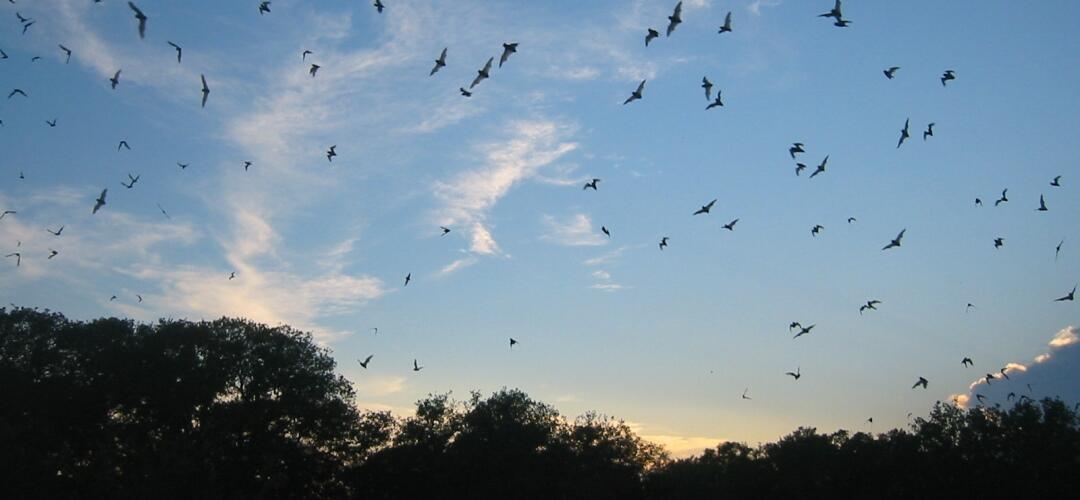
- Bats: Bats save us big bucks by gobbling up insects that damage and kill crops, and pollinating hundreds of plant species. But these agile flyers also face unprecedented threats including habitat loss, disease, and climate change. USGS scientists monitor bat populations across North America to document population changes, estimate extinction risk, set conservation priorities, and evaluate the effectiveness of conservation actions. Learn more>>
- Monarch butterflies: Over the last two decades, the Eastern migratory population of monarch butterflies has declined by 80%. The USGS leads the Monarch Conservation Science Partnership, which helps identify target population sizes, create conservation plants, and monitor the state of monarchs in North America. Learn more>>
- Western bumble bees: The western bumble bee was once common across North America, but since 1998 has undergone a drastic decline, and is currently being considered for listing under the Endangered Species Act. USGS scientists used data from 1998-2020 and found that increasing temperatures, drought, and pesticide are to blame. Learn more>>
Media

What can you do to help endangered bumble bees? Hear from an expert about the importance of bumble bees, the science informing their recovery, and how you can help.
Sources/Usage: Public Domain. View Media Details
Media

Learn how USGS scientists are monitoring migratory birds in Alaska to understand the health of populations and how they’re being affected by climate change.
Sources/Usage: Public Domain. View Media Details
Media

Bats are one of North America’s most misunderstood—yet threatened—mammals. Hear how USGS is guiding the management and recovery of this invaluable member of the animal kingdom.
Sources/Usage: Public Domain. View Media Details
Featured Tools & Techniques
Across the USGS, our scientists are developing decision-support tools and technologies to monitor and assess risks to animals. We develop advanced technologies such as remote sensing, autonomous vehicles, artificial intelligence, and genetic tools to assess the status, behaviors, and health of wildlife populations. From mapping mule deer migrations in the West to monitoring the distribution of monarchs in North America, explore the latest and greatest tools and techniques we’re using to develop a more accurate and comprehensive understanding of our Nation’s wildlife.




Sources/Usage: Public Domain. View Media Details
Science

Landbird Research in Alaska
On this page, learn about USGS work with the Alaska Landbird Monitoring Survey (ALMS), Beak Deformities in Landbirds, and Boreal Partners in Flight (BPIF).

Polar Bear Research
Polar bears ( Ursus maritimus) are one of 4 marine mammal species managed by the U.S. Department of Interior. The USGS Alaska Science Center leads long–term research on polar bears to inform local, state, national and international policy makers regarding conservation of the species and its habitat. Our studies, ongoing since 1985, are focused on population dynamics, health and energetics...

Heat Stress in Alaska's Pacific Salmon
Alaska's freshwater spans a wide range of summer water temperatures, from ice-cold glacier water to warm rivers that routinely reach stressful levels for salmon, exceeding 18°C/64°F and even surpassing 21°C/70°F. Pacific salmon population trends are also varied and include declines in many Chinook salmon populations. Salmon declines are kitchen table issues because salmon fishing is key to the...
Science for management of America’s iconic wild horses and burros
Wild horses and burros are iconic wildlife of the western USA as well as a complicated management issue on tribal, state, and federal lands. Due to their history as domesticated animals, these wild equids – also called “free-roaming” or “feral” equids – can reproduce quickly, and have few natural predators, allowing their populations to grow rapidly if not managed. When populations are too large...

Greater Sage-Grouse Population Monitoring Framework
Greater sage-grouse ( Centrocercus urophasianus) are at the center of state and national land use policies largely because of their unique life-history traits and their role as an ecological indicator for the health of sagebrush ecosystems. Multiple science centers with the U.S. Geological Survey (USGS) in conjunction with Colorado State University (CSU) have developed the Greater Sage-Grouse...
Multimedia

A resting sea otter
A resting sea otter in the Homer harbor, Alaska. Photo was taken in 2011. Sea otters provide one of the best documented examples of top-down forcing effects on the structure and function of nearshore marine ecosystems in the North Pacific Ocean.

Intertidal Zone Invertebrates
This rock is covered with invertebrate animals over nearly the entire surface including orange and purple sea stars, green anemones spotted with shell debris of other animals, and black mussels.
This rock is covered with invertebrate animals over nearly the entire surface including orange and purple sea stars, green anemones spotted with shell debris of other animals, and black mussels.
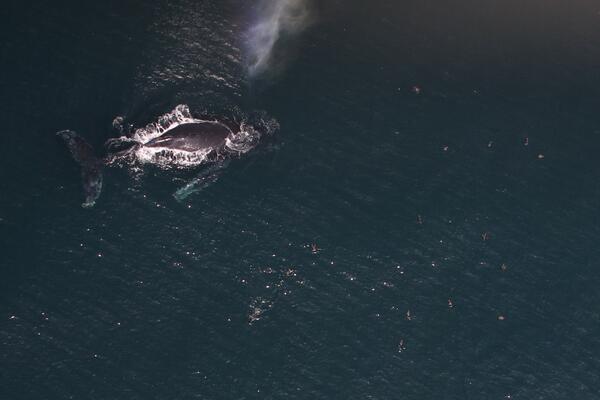
Humpback Whale and shearwaters feeding in southern California
Humpback Whale and shearwaters feeding in southern CaliforniaZoomed image of a Humpback Whale (Megaptera novaeangliae) and a group of shearwaters feeding in southern California.
Humpback Whale and shearwaters feeding in southern California
Humpback Whale and shearwaters feeding in southern CaliforniaZoomed image of a Humpback Whale (Megaptera novaeangliae) and a group of shearwaters feeding in southern California.

Bombus occidentalis, F, Side, Utah Co., Utah
This bumblebee species has almost entirely disappeared from its West Coast range due to a recent epidemic sweeping through some bumblebee populations. However, the Rocky Mountain populations still persist and there is hope that the West Coast population will also recover and resume its place as one of the most common bumblebee species in the West.
This bumblebee species has almost entirely disappeared from its West Coast range due to a recent epidemic sweeping through some bumblebee populations. However, the Rocky Mountain populations still persist and there is hope that the West Coast population will also recover and resume its place as one of the most common bumblebee species in the West.

Columbia torrent salamander (Rhyacotriton kezeri)
Torrent salamanders are Northwest-U.S. endemic, headwater-stream-associated amphibian species that have a dearth of basic ecological information, but are thought to be highly vulnerable to habitat changes.
Torrent salamanders are Northwest-U.S. endemic, headwater-stream-associated amphibian species that have a dearth of basic ecological information, but are thought to be highly vulnerable to habitat changes.

Red fox kits on St. Matthew Island, Alaska
Red fox kits on St. Matthew Island, Alaska
Red fox kits on St. Matthew Island, Alaska

A Common Murre on the water near its colony in Kachemak Bay, Alaska
A Common Murre on the water near its colony in Kachemak Bay, AlaskaNorthern Fulmars, Black-legged Kittiwakes, and Common Murres have all been tested for and contained harmful algal bloom (HAB) toxins in Alaska. Since 2015, the USGS has worked with a variety of stakeholders to develop testing methods and research projects to better understand the geographic extent, timing and impacts of algal toxins in Alaska marine ecosystems.
A Common Murre on the water near its colony in Kachemak Bay, Alaska
A Common Murre on the water near its colony in Kachemak Bay, AlaskaNorthern Fulmars, Black-legged Kittiwakes, and Common Murres have all been tested for and contained harmful algal bloom (HAB) toxins in Alaska. Since 2015, the USGS has worked with a variety of stakeholders to develop testing methods and research projects to better understand the geographic extent, timing and impacts of algal toxins in Alaska marine ecosystems.

Female Pribilof rock sandpiper, St. Matthew Island, Bering Sea
Female Pribilof rock sandpiper, St. Matthew Island, Bering SeaIn 2018, biologists conducted a second population survey to reassess the population status and habitat associations of Pribilof rock sandpipers breeding on St. Matthew and Hall Islands in the Bering Sea, Alaska. Previous work estimated the population size at approximately 19,800 birds (Ruthrauff et al. 2012).
Female Pribilof rock sandpiper, St. Matthew Island, Bering Sea
Female Pribilof rock sandpiper, St. Matthew Island, Bering SeaIn 2018, biologists conducted a second population survey to reassess the population status and habitat associations of Pribilof rock sandpipers breeding on St. Matthew and Hall Islands in the Bering Sea, Alaska. Previous work estimated the population size at approximately 19,800 birds (Ruthrauff et al. 2012).

Female McKay's Bunting on St. Matthew Island
Female McKay's Bunting on St. Matthew Island.
Female McKay's Bunting on St. Matthew Island.
The multimedia items below are a sample of USGS media on animals and do not represent a complete list.
Filter Total Items: 35

Yellow-billed Loon swimming on the Arctic Coastal Plain, Alaska
Yellow-billed Loon swimming on the Arctic Coastal Plain, AlaskaA Yellow-billed Loon swimming in a small lake on the Arctic Coastal Plain.
Yellow-billed Loon swimming on the Arctic Coastal Plain, Alaska
Yellow-billed Loon swimming on the Arctic Coastal Plain, AlaskaA Yellow-billed Loon swimming in a small lake on the Arctic Coastal Plain.

Northern long-eared bat with visible symptoms of WNS
Northern long-eared bat with visible symptoms of WNSMyotis septentrionalis, northern myotis (Vespertilionidae) with growth of Geomyces destructans clearly evident.
Northern long-eared bat with visible symptoms of WNS
Northern long-eared bat with visible symptoms of WNSMyotis septentrionalis, northern myotis (Vespertilionidae) with growth of Geomyces destructans clearly evident.

Barred owl
Barred owls (Strix varia) have expanded their geographic range from eastern to western North America. Their newly expanded range now completely overlaps that of the federally threatened northern spotted owl (S. occidentalis caurina).
Barred owls (Strix varia) have expanded their geographic range from eastern to western North America. Their newly expanded range now completely overlaps that of the federally threatened northern spotted owl (S. occidentalis caurina).

Polar bear on ice in the southern Beaufort Sea, April 8, 2011
Polar bear on ice in the southern Beaufort Sea, April 8, 2011A polar bear walks across rubble ice in the Alaska portion of the southern Beaufort Sea, April 8, 2011
Polar bear on ice in the southern Beaufort Sea, April 8, 2011
Polar bear on ice in the southern Beaufort Sea, April 8, 2011A polar bear walks across rubble ice in the Alaska portion of the southern Beaufort Sea, April 8, 2011

Ruddy Turnstone
The avian paramyxovirus is found across the planet, infect wild and domestic birds, and sometimes lead to disease outbreaks, but according to a new study led by the USGS, wild ducks and shorebirds do not appear to carry these viruses, which can lead to Newcastle disease that sickens or kills poultry.
The avian paramyxovirus is found across the planet, infect wild and domestic birds, and sometimes lead to disease outbreaks, but according to a new study led by the USGS, wild ducks and shorebirds do not appear to carry these viruses, which can lead to Newcastle disease that sickens or kills poultry.

Curious Fellow
A immature elk is very interested in being photographed.
A immature elk is very interested in being photographed.

Common Octopus (Octopus vulgaris)
A Common Octopus (Octopus vulgaris) leaves his den to hunt for conchs and clams.
A Common Octopus (Octopus vulgaris) leaves his den to hunt for conchs and clams.

Caribou crossing the Selawik River, Alaska
Caribou crossing the Selawik River, Alaska

Sunflower sea star on the seafloor
Photograph of the seafloor off the California coast showing coarse sand, shells, and a sunflower sea star. It was taken during a "ground-truthing" survey off of Salt Point, California, in support of the California Seafloor Mapping Program.
Photograph of the seafloor off the California coast showing coarse sand, shells, and a sunflower sea star. It was taken during a "ground-truthing" survey off of Salt Point, California, in support of the California Seafloor Mapping Program.

An Endangered Red Hawksbill Sea Turtle Swims Over a Threatened Elkhorn Coral in Virgin Islands National Park
An Endangered Red Hawksbill Sea Turtle Swims Over a Threatened Elkhorn Coral in Virgin Islands National ParkThis photo shows an endangered hawksbill (Eretmochelys imbricata) swimming over a colony of elkhorn coral (Acropora palmata).
USGS scientists are doing research on sea turtles and corals in Florida and the US Virgin Islands.
An Endangered Red Hawksbill Sea Turtle Swims Over a Threatened Elkhorn Coral in Virgin Islands National Park
An Endangered Red Hawksbill Sea Turtle Swims Over a Threatened Elkhorn Coral in Virgin Islands National ParkThis photo shows an endangered hawksbill (Eretmochelys imbricata) swimming over a colony of elkhorn coral (Acropora palmata).
USGS scientists are doing research on sea turtles and corals in Florida and the US Virgin Islands.

Wolf in Yellowstone National Park
Wolves were reintroduced to Yellowstone National Park in 1995 and 1996.
Wolves were reintroduced to Yellowstone National Park in 1995 and 1996.

Mountain Yellow-Legged Frog (Rana muscosa)
Endangered mountain yellow-legged frog (Rana muscosa).
Endangered mountain yellow-legged frog (Rana muscosa).

Nene adults and goslings
A mating pair of adult nēnē (Branta sandvicensis) keep a close watch on three young goslings. An endangered species and the state bird of Hawai‘i, nēnē are the last remaining species of Hawaiian goose.
A mating pair of adult nēnē (Branta sandvicensis) keep a close watch on three young goslings. An endangered species and the state bird of Hawai‘i, nēnē are the last remaining species of Hawaiian goose.

Boreal toad (Bufo boreas) mating ball
Boreal toad (Bufo boreas) mating ball, Bridger-Teton National Forest, Wyoming.
Boreal toad (Bufo boreas) mating ball, Bridger-Teton National Forest, Wyoming.
Healthy animal and plant communities form the foundation of healthy ecosystems, and in turn, healthy ecosystems benefit humans in countless ways. From the furry to the scaly, USGS science contributes to the restoration, protection, and conservation of fish and wildlife for generations to come.
Animals We Study
As the principal science arm of the U.S. Department of the Interior (DOI), the USGS provides science to help the Nation achieve sustainable management and conservation of plants and animals. Healthy ecosystems contain a diversity of thriving animal populations which makes them more resistant and resilient to threats. Loss of animal species means a loss of biodiversity and thus healthy ecosystems. Declines in animal populations have been documented worldwide due to threats from climate change, disease, and habitat loss. Our scientists monitor at-risk species, identify how animals respond to climate change and habitat loss, and find solutions to address fish wildlife diseases. This information is used by federal, state, and tribal natural resource managers to make management decisions that support our Nation’s fish and wildlife now and into the future. Read on to learn about the animals we study.
Terrestrial Mammals
Terrestrial Mammals
Marine Mammals
Marine Mammals
Reptiles
Reptiles
Amphibians
Amphibians
Fish
Fish
Birds
Birds
Pollinators
Pollinators
Invertebrates
Invertebrates
Threats to Animals
Media
Sources/Usage: Public Domain. View Media Details
Climate change, urbanization, habitat loss, the spread of invasive species – these and other threats pose a significant challenge to wildlife managers. Biological threats to animals like diseases and invasive species can spread through nature and cause an incredible ripple effect on humans. These threats are costly and endanger not only wildlife, but also livestock, agriculture, forestry, public health, water quality, and recreational resources that people rely on.
Understanding, monitoring, and predicting threats to animals contributes to the USGS goal of providing science to support the protection, conservation, and enhancement of the Nation’s biodiversity. USGS scientists study how animal populations are responding to threats and help arm managers and the public with the information and tools they need to choose the most effective management strategies that will support species now and into the future.
Invasive Species
Every plant and animal species has a native habitat where it originated and is part of the natural community. When a species is introduced to a new habitat, it becomes a “non-native” species in that area. And if that non-native species is able to establish and grow in that new habitat, causing harm to the environment, economy, or humans, it becomes “invasive”. The estimated economic and health-related costs of invasive species in the U.S. have been reported at more than \$21 billion annually and adversely affect every state in the country.
The challenges that invasive species pose are innumerable. For example, invasive plants diminish the quality of fish and wildlife habitat, while invasive animals can spread diseases and compete with native animals for resources. USGS scientists study hundreds of invasive species, including invasive carp in the Mississippi River and its tributaries, Burmese pythons in the Everglades, and zebra and quagga mussels in the Great Lakes. Learn more>>
Disease & Contaminants
The effects of diseases, pathogens, contaminants, and toxins are global and profound, often resulting in economic and agricultural impacts, declines in wildlife populations, and ecological disturbance. Through a One Health lens, the USGS works to advance wildlife health science for the benefit of animals, humans, and the environment. We research solutions to address the deadliest wildlife diseases, detect disease-causing pathogens, and monitor the presence of dangerous chemicals and toxins in the environment that can harm people and wildlife. Learn more>>
Ecosystem Change
Media
Sources/Usage: Some content may have restrictions. View Media Details
Change is a natural part of healthy ecosystems. For example, periodic, low-intensity wildfires clear dead brush and help encourage new plant growth. However, in some cases ecosystems are pushed toward irreversible transformations. Threats like climate change, land use change, and the spread of invasive species affect how ecosystems function, which in turn has consequences for the animals, plants, and human communities that rely on them. For example, in the West, climate change is contributing to a longer wildfire season. Fires clear the way for the spread of invasive plants, like cheatgrass, resulting in less good quality habitat and food available for native wildlife like the greater sage-grouse. To make matters worse, cheatgrass is highly flammable and perpetuates cycles of more frequent, intense fires.
This is just one example of how multiple threats to ecosystems – climate change, fire, and invasive species – interact and compound to alter ecosystems and ultimately harm wildlife. USGS scientists study the impacts of these and other threats to ecosystems and the wildlife that depend on them, make predictions about how ecosystems will look in the future and what this means for wildlife, and provide science to inform ecosystem restoration and wildlife conservation. Learn more>>
Species at Risk
As a result of threats such as the spread of invasive species, disease, and climate and land use change, some animal species are in decline or in danger of extinction, and may have specific protections at the federal and state levels. The USGS provides federal and state fish and wildlife managers, and other conservation organizations with scientific information to support conservation decisions for at-risk species. Through monitoring the populations of declining species, USGS science is providing critical information on the status and health of wildlife populations.
Population Monitoring
USGS scientists collect data by going out in the field to survey wildlife or collect remotely sensed data using special detectors such as cameras and satellites. Whether we’re putting GPS collars on caribou to track their migrations, evaluating satellite imagery to see where Pacific walruses are resting on the Arctic coastline, or banding birds to track their behavior, lifespans, and health, USGS scientists are collecting the data needed to make informed management decisions for our Nation’s wildlife.
On Land
-
Grizzly bears: As participants in the Interagency Grizzly Bear Study Team, USGS scientists have been monitoring grizzly bears in Yellowstone for over 40 years—contributing to what is perhaps the largest collection of scientific information on any bear species in the world. Learn more>>
-
Caribou: Arctic caribou have the longest land migrations of any animal on Earth. How will caribou populations and migration patterns be impacted by changes in climate and energy development? USGS scientists are monitoring caribou in northern Alaska to answer these questions and more. Learn more>>
-
Mule deer: Each spring and fall, mule deer and other hoofed mammals migrate throughout the western U.S. to avoid deep snow and access nutritious forage. USGS scientists use GPS collars to track where mule deer migrate, creating maps of deer migration routes that support conservation planning. Learn more>>
-
Sage-grouse: Greater sage-grouse populations have declined significantly over the last 60 years. USGS scientists are estimating population trends for this Great Basin game bird to inform conservation decisions. Learn more>>
-
Amphibians: The U.S. is losing approximately 4% of its amphibian populations each year. Climate change is one of many drivers of amphibian die-offs. USGS scientists are monitoring amphibians on public lands and determining factors that may be causing population declines. Learn more>>
-
Desert tortoise: The threatened desert tortoise has inhabited the Southwest for millions of years. USGS scientists are investigating how changes in southwestern deserts, such as larger and more frequent wildfires, are affecting the species. Learn more>>
Media
Return of the Yellowstone grizzly bear: Hear from the experts about a 40-year long effort to monitor and understand this charismatic animal.
Sources/Usage: Public Domain. View Media Details
Media
Did you know that each species of frog has its own unique vocalization? Learn how USGS scientists are using these frog calls to track populations.
Sources/Usage: Public Domain. View Media Details
Media
Arctic caribou have the longest terrestrial migrations of any animal on Earth. Learn how USGS scientists are using GPS collars to track their movements.
Sources/Usage: Public Domain. View Media Details
In Water
- Polar bears: USGS leads long-term research on polar bears to inform policy and conservation decisions for the species and its Arctic habitat. Scientists are studying two populations in Alaska to understand how rapidly warming temperatures affect polar bear movement, denning, population size, and health. Learn more>>
- Pacific walrus: The Pacific walrus has a wide geographic distribution, which makes it difficult to know just how many there are. However, advances in genetics and drone technology have allowed USGS scientists to develop more precise estimates. Keeping tabs on walrus numbers is especially important as they continue to experience a loss of sea ice habitat. Learn more>>
- Sea Turtles: Six species of sea turtles—all protected by the Endangered Species Act—call U.S. waters home. USGS scientists are studying sea turtle habitat use, movements, and more, in the Gulf of Mexico, Florida Keys, and Caribbean. Learn more>>
- Sea Otters: These hand-holding marine mammals, found along the North Pacific coast, were decimated by the 18th and 19th century fur trade. Today, populations are continuing to recover and USGS scientists are studying the factors that affect sea otter population trends. Learn more>>
- Manatees: The Florida manatee was one of the first species listed as endangered when the Endangered Species Act went into effect in 1973. For the last 40 years, USGS scientists have been committed to understanding the biology and ecology of manatees to help managers identify actions that can help this majestic species thrive. Learn more>>
- Salmon: The Yukon River hosts some of the largest migrating salmon stocks in the world, with some fish migrating over 1,800 miles to reach their spawning grounds in the Yukon and British Columbia. But the Yukon River chinook salmon have been in decline since the 1990s, and the pace of this decline has recently accelerated. USGS scientists are exploring whether heat stress is the cause. Learn more>>
- Atlantic sturgeon: Atlantic sturgeon have been around for at least 70 million years, but populations have been depleted due to overfishing, unintentional deaths caused by commercial vessels and fishing, and habitat loss. USGS scientists are using genetics to help estimate the number of sturgeon in certain spawning runs and to better understand their migratory routes. Learn more>>
- Corals: Coral reefs cover less than 0.5% of the earth's surface but are home to an estimated 25% of all marine species. USGS scientists map, monitor, and model coral reefs to better understand how we can protect these incredibly important ecosystems. Learn more>>
- Stoneflies: The threatened meltwater stonefly and glacier stonefly are restricted to short sections of cold streams fed by disappearing glaciers and permanent snowfields in Glacier National Park. USGS scientists are investigating the impacts of glacier and snow loss on the distribution, abundance, and genetic diversity of these cryptic critters. Learn more>>
Media
How have coral reefs changed over the several decades, and can restoration efforts bring back our reefs? Come hear from an expert!
Sources/Usage: Public Domain. View Media Details
Media
Come take a serene swim through the Florida Panhandle through the eyes of two female loggerhead sea turtles!
Sources/Usage: Public Domain. View Media Details
Media
In 2019, a record heatwave and drought in Alaska caused unprecedented mortality in salmon. Hear from an expert on the future of this species in a warming world.
Sources/Usage: Public Domain. View Media Details
In the Sky
- Birds: The USGS provides information on the status of North America’s bird species through two important programs – the Bird Banding Laboratory and the North American Breeding Bird Survey. Together, these initiatives support effective bird science, management, and conservation across the continent.
- Bats: Bats save us big bucks by gobbling up insects that damage and kill crops, and pollinating hundreds of plant species. But these agile flyers also face unprecedented threats including habitat loss, disease, and climate change. USGS scientists monitor bat populations across North America to document population changes, estimate extinction risk, set conservation priorities, and evaluate the effectiveness of conservation actions. Learn more>>
- Monarch butterflies: Over the last two decades, the Eastern migratory population of monarch butterflies has declined by 80%. The USGS leads the Monarch Conservation Science Partnership, which helps identify target population sizes, create conservation plants, and monitor the state of monarchs in North America. Learn more>>
- Western bumble bees: The western bumble bee was once common across North America, but since 1998 has undergone a drastic decline, and is currently being considered for listing under the Endangered Species Act. USGS scientists used data from 1998-2020 and found that increasing temperatures, drought, and pesticide are to blame. Learn more>>
Media
What can you do to help endangered bumble bees? Hear from an expert about the importance of bumble bees, the science informing their recovery, and how you can help.
Sources/Usage: Public Domain. View Media Details
Media
Learn how USGS scientists are monitoring migratory birds in Alaska to understand the health of populations and how they’re being affected by climate change.
Sources/Usage: Public Domain. View Media Details
Media
Bats are one of North America’s most misunderstood—yet threatened—mammals. Hear how USGS is guiding the management and recovery of this invaluable member of the animal kingdom.
Sources/Usage: Public Domain. View Media Details
Featured Tools & Techniques
Across the USGS, our scientists are developing decision-support tools and technologies to monitor and assess risks to animals. We develop advanced technologies such as remote sensing, autonomous vehicles, artificial intelligence, and genetic tools to assess the status, behaviors, and health of wildlife populations. From mapping mule deer migrations in the West to monitoring the distribution of monarchs in North America, explore the latest and greatest tools and techniques we’re using to develop a more accurate and comprehensive understanding of our Nation’s wildlife.
Sources/Usage: Public Domain. View Media Details
Science
Landbird Research in Alaska
On this page, learn about USGS work with the Alaska Landbird Monitoring Survey (ALMS), Beak Deformities in Landbirds, and Boreal Partners in Flight (BPIF).
Polar Bear Research
Polar bears ( Ursus maritimus) are one of 4 marine mammal species managed by the U.S. Department of Interior. The USGS Alaska Science Center leads long–term research on polar bears to inform local, state, national and international policy makers regarding conservation of the species and its habitat. Our studies, ongoing since 1985, are focused on population dynamics, health and energetics...
Heat Stress in Alaska's Pacific Salmon
Alaska's freshwater spans a wide range of summer water temperatures, from ice-cold glacier water to warm rivers that routinely reach stressful levels for salmon, exceeding 18°C/64°F and even surpassing 21°C/70°F. Pacific salmon population trends are also varied and include declines in many Chinook salmon populations. Salmon declines are kitchen table issues because salmon fishing is key to the...
Science for management of America’s iconic wild horses and burros
Wild horses and burros are iconic wildlife of the western USA as well as a complicated management issue on tribal, state, and federal lands. Due to their history as domesticated animals, these wild equids – also called “free-roaming” or “feral” equids – can reproduce quickly, and have few natural predators, allowing their populations to grow rapidly if not managed. When populations are too large...
Greater Sage-Grouse Population Monitoring Framework
Greater sage-grouse ( Centrocercus urophasianus) are at the center of state and national land use policies largely because of their unique life-history traits and their role as an ecological indicator for the health of sagebrush ecosystems. Multiple science centers with the U.S. Geological Survey (USGS) in conjunction with Colorado State University (CSU) have developed the Greater Sage-Grouse...
Multimedia
A resting sea otter
A resting sea otter in the Homer harbor, Alaska. Photo was taken in 2011. Sea otters provide one of the best documented examples of top-down forcing effects on the structure and function of nearshore marine ecosystems in the North Pacific Ocean.
A resting sea otter in the Homer harbor, Alaska. Photo was taken in 2011. Sea otters provide one of the best documented examples of top-down forcing effects on the structure and function of nearshore marine ecosystems in the North Pacific Ocean.
Intertidal Zone Invertebrates
This rock is covered with invertebrate animals over nearly the entire surface including orange and purple sea stars, green anemones spotted with shell debris of other animals, and black mussels.
This rock is covered with invertebrate animals over nearly the entire surface including orange and purple sea stars, green anemones spotted with shell debris of other animals, and black mussels.
Humpback Whale and shearwaters feeding in southern California
Humpback Whale and shearwaters feeding in southern CaliforniaZoomed image of a Humpback Whale (Megaptera novaeangliae) and a group of shearwaters feeding in southern California.
Humpback Whale and shearwaters feeding in southern California
Humpback Whale and shearwaters feeding in southern CaliforniaZoomed image of a Humpback Whale (Megaptera novaeangliae) and a group of shearwaters feeding in southern California.
Bombus occidentalis, F, Side, Utah Co., Utah
This bumblebee species has almost entirely disappeared from its West Coast range due to a recent epidemic sweeping through some bumblebee populations. However, the Rocky Mountain populations still persist and there is hope that the West Coast population will also recover and resume its place as one of the most common bumblebee species in the West.
This bumblebee species has almost entirely disappeared from its West Coast range due to a recent epidemic sweeping through some bumblebee populations. However, the Rocky Mountain populations still persist and there is hope that the West Coast population will also recover and resume its place as one of the most common bumblebee species in the West.
Columbia torrent salamander (Rhyacotriton kezeri)
Torrent salamanders are Northwest-U.S. endemic, headwater-stream-associated amphibian species that have a dearth of basic ecological information, but are thought to be highly vulnerable to habitat changes.
Torrent salamanders are Northwest-U.S. endemic, headwater-stream-associated amphibian species that have a dearth of basic ecological information, but are thought to be highly vulnerable to habitat changes.
Red fox kits on St. Matthew Island, Alaska
Red fox kits on St. Matthew Island, Alaska
Red fox kits on St. Matthew Island, Alaska
A Common Murre on the water near its colony in Kachemak Bay, Alaska
A Common Murre on the water near its colony in Kachemak Bay, AlaskaNorthern Fulmars, Black-legged Kittiwakes, and Common Murres have all been tested for and contained harmful algal bloom (HAB) toxins in Alaska. Since 2015, the USGS has worked with a variety of stakeholders to develop testing methods and research projects to better understand the geographic extent, timing and impacts of algal toxins in Alaska marine ecosystems.
A Common Murre on the water near its colony in Kachemak Bay, Alaska
A Common Murre on the water near its colony in Kachemak Bay, AlaskaNorthern Fulmars, Black-legged Kittiwakes, and Common Murres have all been tested for and contained harmful algal bloom (HAB) toxins in Alaska. Since 2015, the USGS has worked with a variety of stakeholders to develop testing methods and research projects to better understand the geographic extent, timing and impacts of algal toxins in Alaska marine ecosystems.
Female Pribilof rock sandpiper, St. Matthew Island, Bering Sea
Female Pribilof rock sandpiper, St. Matthew Island, Bering SeaIn 2018, biologists conducted a second population survey to reassess the population status and habitat associations of Pribilof rock sandpipers breeding on St. Matthew and Hall Islands in the Bering Sea, Alaska. Previous work estimated the population size at approximately 19,800 birds (Ruthrauff et al. 2012).
Female Pribilof rock sandpiper, St. Matthew Island, Bering Sea
Female Pribilof rock sandpiper, St. Matthew Island, Bering SeaIn 2018, biologists conducted a second population survey to reassess the population status and habitat associations of Pribilof rock sandpipers breeding on St. Matthew and Hall Islands in the Bering Sea, Alaska. Previous work estimated the population size at approximately 19,800 birds (Ruthrauff et al. 2012).
Female McKay's Bunting on St. Matthew Island
Female McKay's Bunting on St. Matthew Island.
Female McKay's Bunting on St. Matthew Island.
The multimedia items below are a sample of USGS media on animals and do not represent a complete list.
Filter Total Items: 35
Yellow-billed Loon swimming on the Arctic Coastal Plain, Alaska
Yellow-billed Loon swimming on the Arctic Coastal Plain, AlaskaA Yellow-billed Loon swimming in a small lake on the Arctic Coastal Plain.
Yellow-billed Loon swimming on the Arctic Coastal Plain, Alaska
Yellow-billed Loon swimming on the Arctic Coastal Plain, AlaskaA Yellow-billed Loon swimming in a small lake on the Arctic Coastal Plain.
Northern long-eared bat with visible symptoms of WNS
Northern long-eared bat with visible symptoms of WNSMyotis septentrionalis, northern myotis (Vespertilionidae) with growth of Geomyces destructans clearly evident.
Northern long-eared bat with visible symptoms of WNS
Northern long-eared bat with visible symptoms of WNSMyotis septentrionalis, northern myotis (Vespertilionidae) with growth of Geomyces destructans clearly evident.
Barred owl
Barred owls (Strix varia) have expanded their geographic range from eastern to western North America. Their newly expanded range now completely overlaps that of the federally threatened northern spotted owl (S. occidentalis caurina).
Barred owls (Strix varia) have expanded their geographic range from eastern to western North America. Their newly expanded range now completely overlaps that of the federally threatened northern spotted owl (S. occidentalis caurina).
Polar bear on ice in the southern Beaufort Sea, April 8, 2011
Polar bear on ice in the southern Beaufort Sea, April 8, 2011A polar bear walks across rubble ice in the Alaska portion of the southern Beaufort Sea, April 8, 2011
Polar bear on ice in the southern Beaufort Sea, April 8, 2011
Polar bear on ice in the southern Beaufort Sea, April 8, 2011A polar bear walks across rubble ice in the Alaska portion of the southern Beaufort Sea, April 8, 2011
Ruddy Turnstone
The avian paramyxovirus is found across the planet, infect wild and domestic birds, and sometimes lead to disease outbreaks, but according to a new study led by the USGS, wild ducks and shorebirds do not appear to carry these viruses, which can lead to Newcastle disease that sickens or kills poultry.
The avian paramyxovirus is found across the planet, infect wild and domestic birds, and sometimes lead to disease outbreaks, but according to a new study led by the USGS, wild ducks and shorebirds do not appear to carry these viruses, which can lead to Newcastle disease that sickens or kills poultry.
Curious Fellow
A immature elk is very interested in being photographed.
A immature elk is very interested in being photographed.
Common Octopus (Octopus vulgaris)
A Common Octopus (Octopus vulgaris) leaves his den to hunt for conchs and clams.
A Common Octopus (Octopus vulgaris) leaves his den to hunt for conchs and clams.
Caribou crossing the Selawik River, Alaska
Caribou crossing the Selawik River, Alaska
Sunflower sea star on the seafloor
Photograph of the seafloor off the California coast showing coarse sand, shells, and a sunflower sea star. It was taken during a "ground-truthing" survey off of Salt Point, California, in support of the California Seafloor Mapping Program.
Photograph of the seafloor off the California coast showing coarse sand, shells, and a sunflower sea star. It was taken during a "ground-truthing" survey off of Salt Point, California, in support of the California Seafloor Mapping Program.
An Endangered Red Hawksbill Sea Turtle Swims Over a Threatened Elkhorn Coral in Virgin Islands National Park
An Endangered Red Hawksbill Sea Turtle Swims Over a Threatened Elkhorn Coral in Virgin Islands National ParkThis photo shows an endangered hawksbill (Eretmochelys imbricata) swimming over a colony of elkhorn coral (Acropora palmata).
USGS scientists are doing research on sea turtles and corals in Florida and the US Virgin Islands.
An Endangered Red Hawksbill Sea Turtle Swims Over a Threatened Elkhorn Coral in Virgin Islands National Park
An Endangered Red Hawksbill Sea Turtle Swims Over a Threatened Elkhorn Coral in Virgin Islands National ParkThis photo shows an endangered hawksbill (Eretmochelys imbricata) swimming over a colony of elkhorn coral (Acropora palmata).
USGS scientists are doing research on sea turtles and corals in Florida and the US Virgin Islands.
Wolf in Yellowstone National Park
Wolves were reintroduced to Yellowstone National Park in 1995 and 1996.
Wolves were reintroduced to Yellowstone National Park in 1995 and 1996.
Mountain Yellow-Legged Frog (Rana muscosa)
Endangered mountain yellow-legged frog (Rana muscosa).
Endangered mountain yellow-legged frog (Rana muscosa).
Nene adults and goslings
A mating pair of adult nēnē (Branta sandvicensis) keep a close watch on three young goslings. An endangered species and the state bird of Hawai‘i, nēnē are the last remaining species of Hawaiian goose.
A mating pair of adult nēnē (Branta sandvicensis) keep a close watch on three young goslings. An endangered species and the state bird of Hawai‘i, nēnē are the last remaining species of Hawaiian goose.
Boreal toad (Bufo boreas) mating ball
Boreal toad (Bufo boreas) mating ball, Bridger-Teton National Forest, Wyoming.
Boreal toad (Bufo boreas) mating ball, Bridger-Teton National Forest, Wyoming.