U.S. flag

An official website of the United States government

Earth Resources Observation and Science (EROS) Center

The U.S. Geological Survey's (USGS) Earth Resources Observation and Science (EROS) Center in Sioux Falls, South Dakota, is a global leader in land imaging, using remotely sensed data to track how Earth is changing. EROS provides reliable, science-based information to help decision-makers understand how shifts in land use, cover, and condition affect people and the environment. 

This work is supported by an authoritative national archive of Earth observation data—housing more than 85 years of satellite and aerial records, including the complete Landsat collection. As the operational home of Landsat 8 and 9, EROS delivers daily observations that inform natural resource assessments, support national security, and help communities prepare for the future.

News

Using Landsat Data: More Helpful Tutorials Now Available

Using Landsat Data: More Helpful Tutorials Now Available

Latest in Landsat - January 2026 - Vol. 5 | Issue 1

Latest in Landsat - January 2026 - Vol. 5 | Issue 1

Landsat in 2025: Milestones Continue the Mission's Legacy

Landsat in 2025: Milestones Continue the Mission's Legacy

Publications

Origins, evolutions, and future directions of Landsat science products for advancing global inland water and coastal ocean observations Origins, evolutions, and future directions of Landsat science products for advancing global inland water and coastal ocean observations

In April 2020, the U.S. Geological Survey (USGS) Earth Resources Observation and Science (EROS) Center introduced a Level 2 provisional Aquatic Reflectance (AR) product for the Landsat 8 Operational Land Imager (OLI), marking the initial phase in developing a standardized global product for Landsat-derived surface water measurements. The goal of USGS EROS aquatic product research and...
Authors
Benjamin Page, Christopher J. Crawford, Saeed Arab, Gail Schmidt, Christopher Barnes, Danika F. Wellington

ECCOE Landsat Quarterly Calibration and Validation Report—Quarter 2, 2025 ECCOE Landsat Quarterly Calibration and Validation Report—Quarter 2, 2025

Executive Summary The U.S. Geological Survey Earth Resources Observation and Science Calibration and Validation (Cal/Val) Center of Excellence (ECCOE) focuses on improving the accuracy, precision, calibration, and product quality of remote- sensing data, leveraging years of multiscale optical system geometric and radiometric calibration and characterization experience. The ECCOE Landsat...
Authors
Md Obaidul Haque, Nahid Hasan, Ashish Shrestha, Rajagopalan Rengarajan, Mark Lubke, Daniel Steinwand, Paul Bresnahan, Jerad L. Shaw, Kathryn Ruslander, Esad Micijevic, Michael J. Choate, Cody Anderson, Jeff Clauson, Kurt Thome, Amit Angal, Raviv Levy, Jeff Miller, Leibo Ding, Cibele Teixeira Pinto

A laboratory-based spectrometer intercomparison for the measurement of snow spectra A laboratory-based spectrometer intercomparison for the measurement of snow spectra

Seasonal snow is an integral component of global hydrological systems, global energy budget and Earth's climate. As an important part of many Earth systems, seasonal snow is also an essential source of water for many human populations and ecosystems around the world. As such, the measurement of seasonal snow and characterization of uncertainty in those measurements is crucial. To...
Authors
Benjamin M. Roberts-Pierel, Christopher J. Crawford, Steven W. Brown, Raymond F. Kokaly, Kelly E. Gleason, Anne W. Nolin, Edward H. Bair, Brenton A. Wilder, Anton J. Surunis, S. McKenzie K. Skiles, Joachim Meyer, Allyson E. Fitts, Jeremy M. Johnston, Adam G. Hunsaker, Martin Steufer, Trond Løke

Science

USGS Sagebrush Science: Supporting Public Safety and Economic Decision Making Across the West
The sagebrush biome is one of the largest ecosystems in North America. Encompassing nearly one-third of the continental U.S., it provides critical resources for millions of Americans and a home for hundreds of plants and animal species in the West. Natural resource management in sagebrush ecosystems can be complex, and science can support management decisions by providing knowledge and tools to...
USGS Sagebrush Science: Supporting Public Safety and Economic Decision Making Across the West

USGS Sagebrush Science: Supporting Public Safety and Economic Decision Making Across the West

The sagebrush biome is one of the largest ecosystems in North America. Encompassing nearly one-third of the continental U.S., it provides critical resources for millions of Americans and a home for hundreds of plants and animal species in the West. Natural resource management in sagebrush ecosystems can be complex, and science can support management decisions by providing knowledge and tools to...
Learn More

Land Processes Distributed Active Archive Center
The Land Processes Distributed Active Archive Center (LP DAAC) operates as a partnership between the United States Geological Survey (USGS) and the National Aeronautics and Space Administration (NASA) dedicated to enabling natural resource managers, disaster responders, academia, and industry to investigate, characterize, and monitor land surface processes.
Land Processes Distributed Active Archive Center

Land Processes Distributed Active Archive Center

The Land Processes Distributed Active Archive Center (LP DAAC) operates as a partnership between the United States Geological Survey (USGS) and the National Aeronautics and Space Administration (NASA) dedicated to enabling natural resource managers, disaster responders, academia, and industry to investigate, characterize, and monitor land surface processes.
Learn More
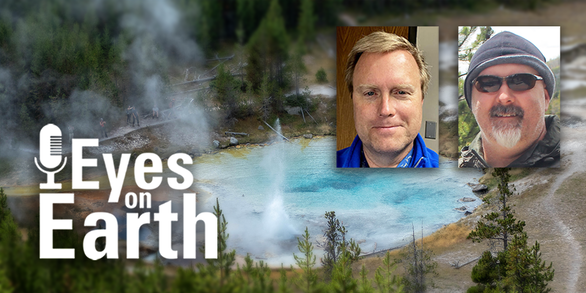
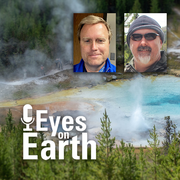
Eyes on Earth Episode 137 – Landsat Takes Yellowstone’s Temperature

Eyes on Earth Episode 137 – Landsat Takes Yellowstone’s Temperature

How do you keep track of thousands of hot spots in an area the size of Yellowstone National Park? Check out thermal satellite data like Landsat’s!
Learn More
Was this page helpful?