



Sound Waves Newsletter: February-March 2025
Featuring coastal and ocean science from across the USGS
Featuring coastal and ocean science from across the USGS
APPROACH (APplying Proxy-based Reconstruction Of Atlantic Climate CHange)
Geologic framework and Holocene sand thickness offshore of Seven Mile Island, New Jersey
SPCMSC Team surveys Madeira Beach
USGS Scientists will provide training to the National Weather Service on Total Water Level and Coastal Change Forecasts
USGS St. Petersburg staff attends Geotools 2025 Conference
Site visit for Tampa Bay hard clam growth study
USGS Scientists publish article on marsh erosion and migration in coastal Mississippi and Alabama
USGS Scientists publish article describing the application of regressive modeling techniques to improve marsh unit thickness data in coastal Alabama and Mississippi
MERMAID
Metagenomic Examinations of Reefs; Microbial Assessments Including Disease
Metagenomic Examinations of Reefs; Microbial Assessments Including Disease
Discover Coastal and Marine Science of the USGS St. Petersburg
An interactive geonarrative will take you on a guided journey to explore the research, capabilities, and history of the center
An interactive geonarrative will take you on a guided journey to explore the research, capabilities, and history of the center
Explore the history of the St. Petersburg Coastal and Marine Science Center
St. Petersburg Coastal and Marine Science Center
Research programs have a primary focus of investigating processes related to coastal and marine environments and societal implications related to natural hazards, resource sustainability, and environmental change.
Science
Science

Read about our science projects, find out where we are working, and why it matters.
Publications
Publications

Peer-reviewed research results and conclusions, authored by Center scientists.
News
USGS Science Shared at St. Petersburg Science Festival
USGS Science Shared at St. Petersburg Science Festival
Sound Waves Newsletter: December 2025-January 2026
Sound Waves Newsletter: December 2025-January 2026
Photo Roundup: December 2025-January 2026
Photo Roundup: December 2025-January 2026
Publications
Assessment of antibiotic resistance genes in Caribbean corals, including those treated with amoxicillin Assessment of antibiotic resistance genes in Caribbean corals, including those treated with amoxicillin
The decimation of reefs from stony coral tissue loss disease prompted the use of a topical amoxicillin treatment to prevent coral mortality. Application of this treatment led to concerns about unintentional impacts such as potential alteration of the coral microbiome and possible spread of antibiotic resistance. We used three different methodologies—microbial RNA sequencing, 16S rRNA...
Long- versus short-term changes in seafloor elevation and volume of the Upper Florida Keys Reef Tract: 1935–2002 and 2002–2016 Long- versus short-term changes in seafloor elevation and volume of the Upper Florida Keys Reef Tract: 1935–2002 and 2002–2016
Coral reefs provide immense ecosystem and economic value, supporting biodiversity, fisheries, tourism, and coastal protection worth billions annually. However, widespread degradation from thermal stress, storms, disease, and human impacts has caused significant coral cover and reef structure loss, increasing coastal vulnerability and economic risks. While coral loss is well-documented...
Shallow geologic framework of the Mississippi Sound and the potential for sediment resources Shallow geologic framework of the Mississippi Sound and the potential for sediment resources
The Mississippi Sound, an estuarine environment located between the mainland and barrier islands bordering the northern Gulf of America (formerly the Gulf of Mexico), serves as a vital ecosystem for the States of Mississippi and Alabama. Spanning approximately 100 kilometers from east to west and covering 1,400 square kilometers, the sound is home to marine industry and ports, and its...
Science
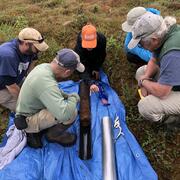
Paleoscience for Partners: Reconstructing the Past to Prepare for the Future
Scientists from the USGS Ecosystems Land Change Science Program are at the forefront of unraveling mysteries of the past to help partners prepare for future environmental conditions.

Seafloor Benthic Mapping and Characterization: Enhancing our Understanding of Aleutian Islands’ Hazards, Potential Seabed Minerals and Deep Corals
A USGS-led expedition in the Aleutian Arc off Alaska will provide critical information on energy resources, underwater earthquakes and other hazards, seafloor habitats, and biological resources, including key fisheries, as well as potential seabed minerals.
By
Ecosystems Mission Area, Natural Hazards Mission Area, Coastal and Marine Hazards and Resources Program, Land Management Research Program, Species Management Research Program, Eastern Ecological Science Center, Pacific Coastal and Marine Science Center, St. Petersburg Coastal and Marine Science Center, Wetland and Aquatic Research Center , Woods Hole Coastal and Marine Science Center, Hawaiian Volcano Observatory, Deep Sea Exploration, Mapping and Characterization

Decoding Harmful Algal Blooms: Unraveling the Mystery
Harmful algal blooms (HABs) are a significant environmental concern due to their potential effects on health, ecosystems, and economies. Algal toxins, which are toxic compounds produced by certain species of cyanobacteria and algae, are commonly linked to these blooms. It's important to note that algal toxins can still be present even when a bloom is not visible, highlighting the need for ongoing...
By
Ecosystems Mission Area, Contaminant Biology, Environmental Health Program, Toxic Substances Hydrology, California Water Science Center, Caribbean-Florida Water Science Center (CFWSC), Maryland-Delaware-D.C. Water Science Center, National Wildlife Health Center, Nevada Water Science Center, New England Water Science Center, New Jersey Water Science Center, New Mexico Water Science Center, South Atlantic Water Science Center (SAWSC), St. Petersburg Coastal and Marine Science Center, Upper Midwest Environmental Sciences Center, Upper Midwest Water Science Center