



Sound Waves Newsletter: Summer 2026
Featuring coastal and ocean science from across the USGS
Featuring coastal and ocean science from across the USGS
USGS Awarded NOAA Effects of Sea Level Rise (ESLR) Grant
USGS Scientists will provide training to the National Weather Service on Total Water Level and Coastal Change Forecasts
New USGS Study Shows How Barrier Island Geomorphology Altered Sediment Distribution During and After Hurricane Sandy, Impacting Future Island Storm Resistance
USGS Study Analyzes the Skill of Probabilistic Forecasts of Overwash and Inundation Along the Texas and Louisiana Coast
USGS Scientists Publish Paper Reporting a Multi-Project Assessment of Decision Makers’ Needs for Coastal Marsh Models
Discover Coastal and Marine Science of the USGS St. Petersburg
An interactive geonarrative will take you on a guided journey to explore the research, capabilities, and history of the center
An interactive geonarrative will take you on a guided journey to explore the research, capabilities, and history of the center
Explore the history of the St. Petersburg Coastal and Marine Science Center
St. Petersburg Coastal and Marine Science Center
Research programs have a primary focus of investigating processes related to coastal and marine environments and societal implications related to natural hazards, resource sustainability, and environmental change.
Science
Science

Read about our science projects, find out where we are working, and why it matters.
Publications
Publications

Peer-reviewed research results and conclusions, authored by Center scientists.
News
Sound Waves Newsletter: Summer 2026
Sound Waves Newsletter: Summer 2026
USGS Awarded NOAA Effects of Sea Level Rise (ESLR) Grant
USGS Awarded NOAA Effects of Sea Level Rise (ESLR) Grant
New USGS Study Shows How Barrier Island Geomorphology Altered Sediment Distribution During and After Hurricane Sandy, Impacting Future Island Storm Resistance
New USGS Study Shows How Barrier Island Geomorphology Altered Sediment Distribution During and After Hurricane Sandy, Impacting Future Island Storm Resistance
Publications
Flood-inundation maps for Río Grande de Arecibo in and near Utuado Municipio, Puerto Rico, 2026 Flood-inundation maps for Río Grande de Arecibo in and near Utuado Municipio, Puerto Rico, 2026
The U.S. Geological Survey (USGS) created digital flood-inundation maps for a 3.4-mile reach of Río Grande de Arecibo in the municipality of Utuado Municipio, Puerto Rico. Water-surface profiles were computed for the stream reach by using a one-dimensional, steady-state, step-backwater model. This model was calibrated to the current (2026) stage-streamflow relation (rating curve number...
Barrier island geomorphic complexity drives storm and post-storm response Barrier island geomorphic complexity drives storm and post-storm response
Barrier islands are at the forefront of climate-driven changes, with their resiliency threatened by rapid fluctuations in the physical drivers that shape them. Quantifying magnitudes and directions of storm-driven sediment fluxes and rates and modes of sediment recovery is essential for predicting barrier island trajectories. Yet scarce shoreface observations have limited such efforts...
Shifting phenology in planktonic foraminifera in the Gulf of America (Mexico) with 21st century warming Shifting phenology in planktonic foraminifera in the Gulf of America (Mexico) with 21st century warming
We investigate trends in foraminiferal phenology using a 12-year (2008–2020), well-resolved (7 to 28-day resolution) time series of planktonic foraminiferal fluxes from a U.S. Geological Survey sediment trap in the northern Gulf of America (Gulf of Mexico; 27.5°N, 90.3°W). The total foraminiferal flux declined over this time. We used Horn-Morisita dissimilarity analysis, principal...
Science
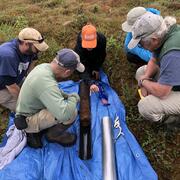
Paleoscience for Partners: Reconstructing the Past to Prepare for the Future
Scientists from the USGS Ecosystems Land Change Science Program are at the forefront of unraveling mysteries of the past to help partners prepare for future environmental conditions.

Seafloor Benthic Mapping and Characterization: Enhancing our Understanding of Aleutian Islands’ Hazards, Potential Seabed Minerals and Deep Corals
A USGS-led expedition in the Aleutian Arc off Alaska will provide critical information on energy resources, underwater earthquakes and other hazards, seafloor habitats, and biological resources, including key fisheries, as well as potential seabed minerals.
By
Ecosystems Mission Area, Natural Hazards Mission Area, Coastal and Marine Hazards and Resources Program, Land Management Research Program, Species Management Research Program, Eastern Ecological Science Center, Pacific Coastal and Marine Science Center, St. Petersburg Coastal and Marine Science Center, Wetland and Aquatic Research Center , Woods Hole Coastal and Marine Science Center, Hawaiian Volcano Observatory, Deep Sea Exploration, Mapping and Characterization

Decoding Harmful Algal Blooms: Unraveling the Mystery
Harmful algal blooms (HABs) are a significant environmental concern due to their potential effects on health, ecosystems, and economies. Algal toxins, which are toxic compounds produced by certain species of cyanobacteria and algae, are commonly linked to these blooms. It's important to note that algal toxins can still be present even when a bloom is not visible, highlighting the need for ongoing...
By
Ecosystems Mission Area, Contaminant Biology, Environmental Health Program, Toxic Substances Hydrology, California Water Science Center, Caribbean-Florida Water Science Center (CFWSC), Maryland-Delaware-D.C. Water Science Center, National Wildlife Health Center, Nevada Water Science Center, New England Water Science Center, New Jersey Water Science Center, New Mexico Water Science Center, South Atlantic Water Science Center (SAWSC), St. Petersburg Coastal and Marine Science Center, Upper Midwest Environmental Sciences Center, Upper Midwest Water Science Center